2026-06-07 中華人民共和国・香港大学 (HKU)
<関連情報>
- https://www.hku.hk/press/press-releases/detail/29161.html
- https://www.nature.com/articles/s41467-026-70963-6
炭化ケイ素におけるゲート制御負性微分抵抗を用いた極低温ニューロモルフィック回路 Cryogenic neuromorphic circuits using gate-controlled negative differential resistance in silicon carbide
Xin Yang (杨鑫),Matthew Porter,Yuan Qin (覃愿),Zineng Yang (杨字能),Hehe Gong (巩贺贺),Liyang Jin (金俪阳),Zichen Xi (席子琛),Han Wang (汪涵),Liyan Zhu (竹立岩),Yuhao Zhang (张宇昊) & Linbo Shao (邵林博)
Nature Communications Published:23 March 2026
DOI:https://doi.org/10.1038/s41467-026-70963-6
Abstract
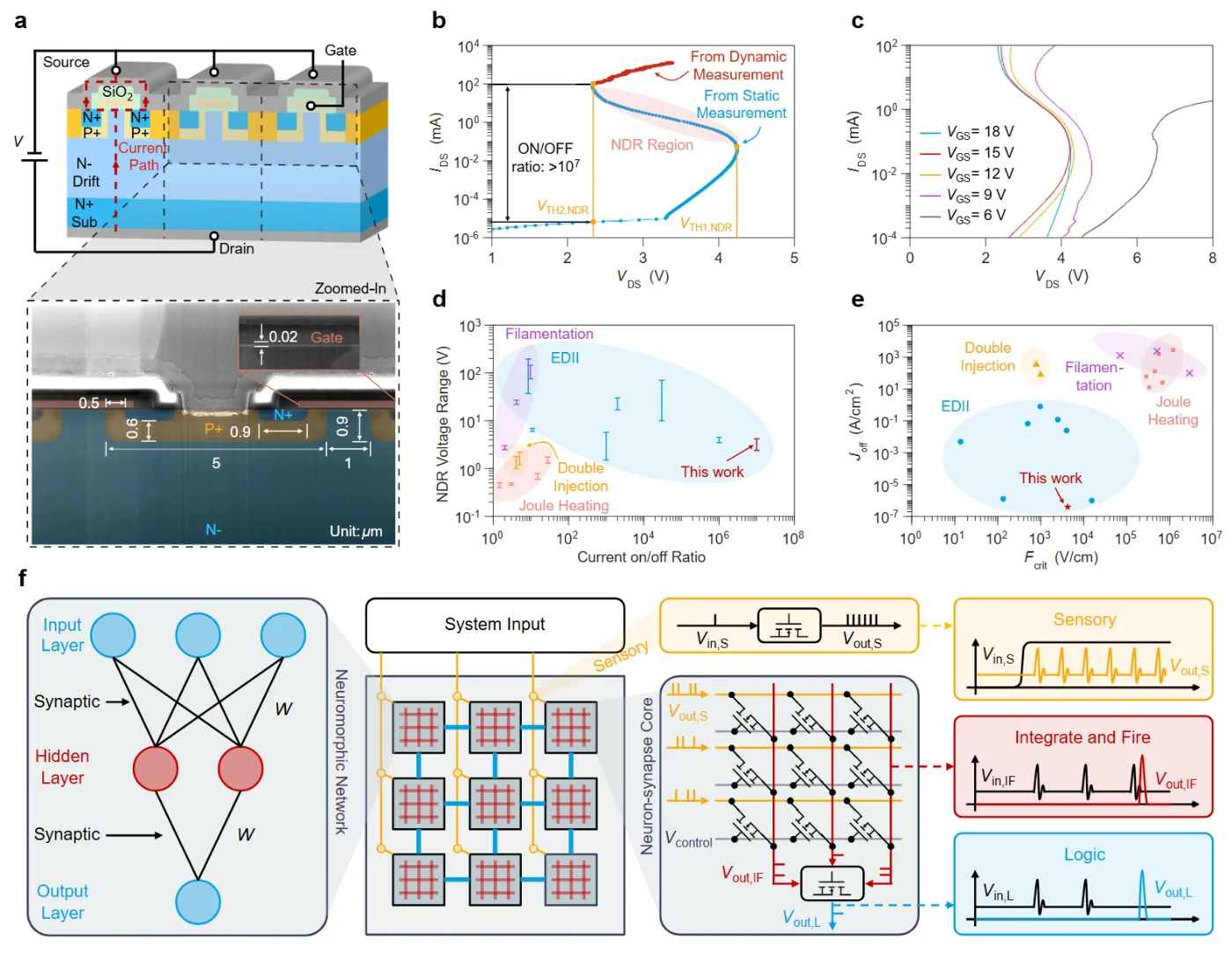
Cryogenic electronic circuits are crucial for interfacing and controlling scalable quantum computing platforms at millikelvin temperatures, yet face stringent thermal constraints demanding ultra-low power operation. Neuromorphic circuits, emulating the spiking behavior of biological neurons, offer solution for achieving energy-efficient electronics under these conditions. Here, we report the gate-controlled negative differential resistance (NDR) in silicon carbide (SiC) metal-oxide-semiconductor field-effect transistors (MOSFETs). This NDR effect, arising from electron-donor impact ionization (EDII) in SiC MOSFET, achieves on/off current ratio over 107. Meanwhile, the behavior of NDR can be fully controlled by the gate voltage of the MOSFET. Leveraging this gate-controlled NDR, we demonstrate programmable cryogenic spiking neuromorphic circuits, including sensory, logic, and integrate-and-fire neurons, with functionality tuned by gate or drain voltages. The established manufacturability of SiC technology highlights the potential of this approach for scalable integration in cryogenic systems for sensing, computing, and quantum information.