2026-08-20 東京科学大学
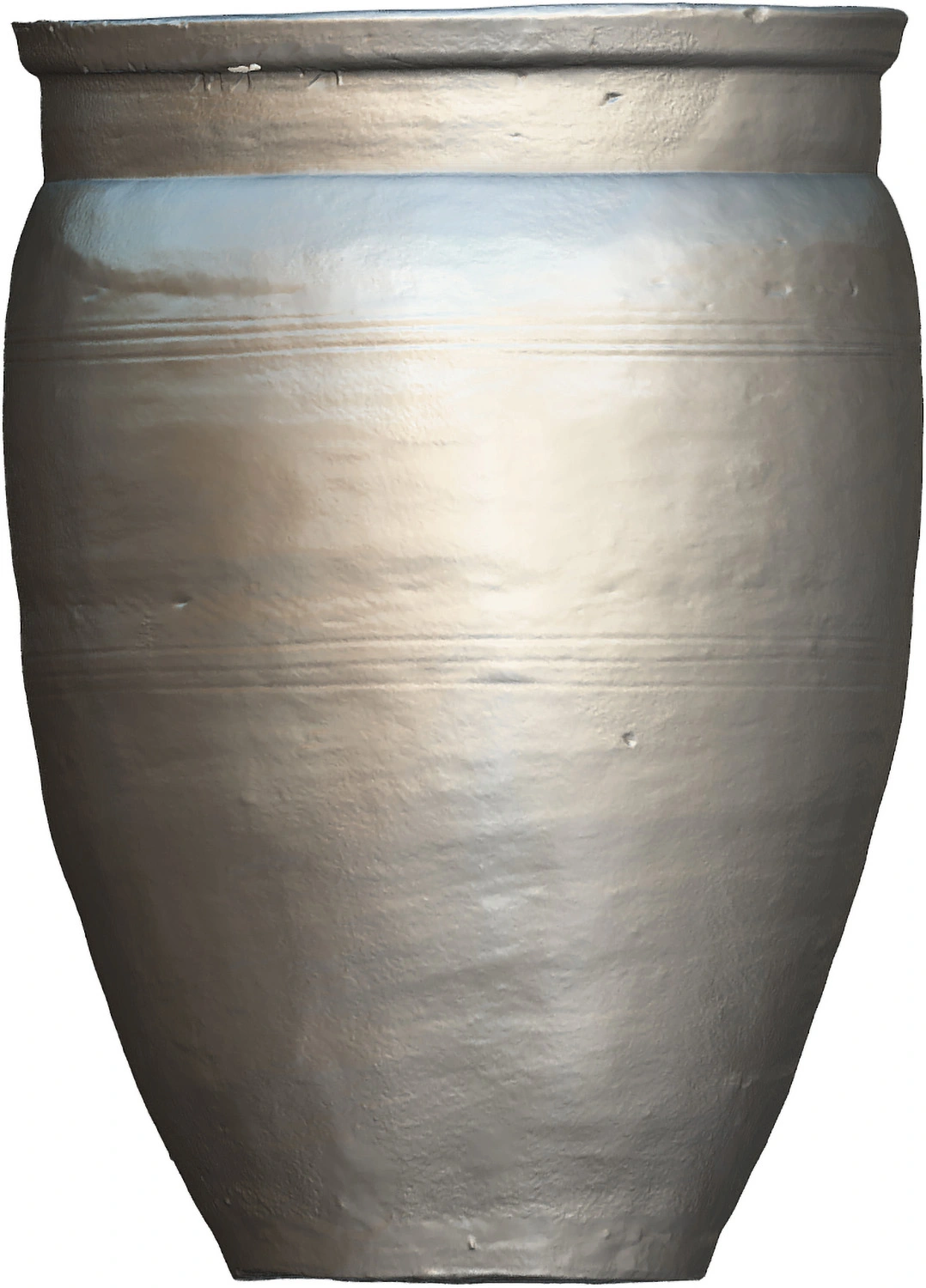
図1. 遺体を納める甕棺として使われた大甕の3Dスキャン。水や醤油の貯蔵から埋葬まで江戸の暮らしと死を支えた万能容器である。(3Dモデル作成:著者)
<関連情報>
- https://www.isct.ac.jp/ja/news/ubwzcx2yoheh
- https://www.degruyterbrill.com/document/doi/10.1515/opar-2025-0083/html
水・醤油・糞・死:幾何学的形態測定学と機械学習を用いた江戸時代「大甕」の形態変化分析 Water, Soy Sauce, Feces, and Death: A Geometric Morphometric and Machine Learning Analysis of Edo-Period Ogame Jars, Japan
James Frances Loftus
Open Archaeology Published: August 19, 2026
DOI:https://doi.org/10.1515/opar-2025-0083
Abstract
The stoneware ‘Ogame’ (“large jar”) produced in Hizen Province, Kyushu, during Japan’s Edo period (1603–1868) served diverse domestic and mortuary functions, from storing water, soy sauce, and fertilizer to containing human remains in burial contexts. Previous scholars have suggested that key historical developments, including the Qing Dynasty ‘sea ban’ (1647–1684) and the rise of mass-produced porcelain in Hizen, contributed to increasing morphological standardization in both porcelain and stoneware. However, no prior morphometric study has tested this hypothesis for Ogame jars. This study applies two-dimensional, outline-based Geometric Morphometrics (GMM) and machine learning-based ‘Random Forest’ classification to assess shape variability in a dataset of 243 jars from kiln and mortuary contexts across Hizen and Chikuzen Provinces (present day Saga and Fukuoka prefectures). Results show (1) a statistically significant negative trend in within-stage dispersion across the Edo period, and (2) a pronounced morphological divergence between mortuary and kiln-associated jars. These findings reveal how Edo-period Ogame shape was influenced by temporal processes of standardization and context-specific demands for mortuary and domestic use. By integrating quantitative morphometric tools with machine learning classification, this exploratory study provides a replicable framework for investigating shape change in historical ceramics with limited chronological resolution.