2026-08-20 神戸大学
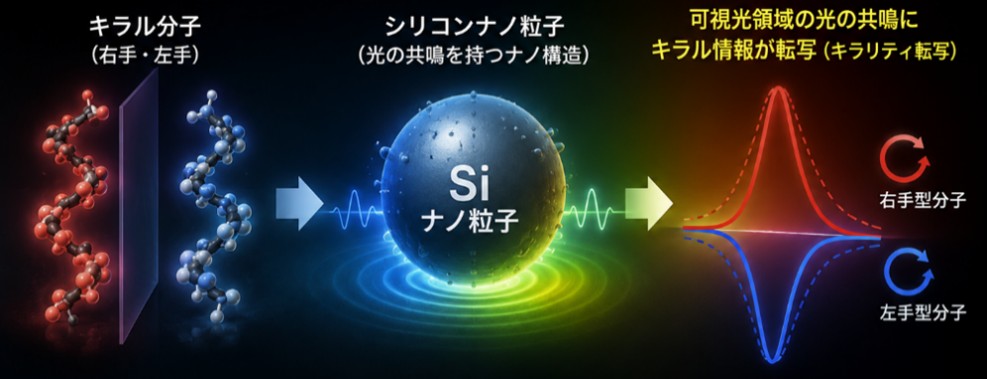
図1:シリコンナノ粒子へのキラリティ転写の概念図。©杉本泰(CC BY)
<関連情報>
- https://www.kobe-u.ac.jp/ja/news/article/20260819-68205/
- https://pubs.acs.org/nalefd/article-abstract/26/32/10802/5251038/Chirality-Transfer-from-Chiral-Molecules-to-Mie
キラル分子からミー共鳴シリコンナノ粒子へのキラリティ伝達 Chirality Transfer from Chiral Molecules to Mie-Resonant Silicon Nanoparticles
Hiroki Kasai;Kento Shintani;Mojtaba Karimi Habil;Hiroaki Hasebe;Shahin Ghamari;Frank Vollmer;Hiroshi Sugimoto;Minoru Fujii
Nano Letters Published:August 10, 2026
DOI:https://doi.org/10.1021/acs.nanolett.6c02584
Abstract
Advances in nanophotonics have enabled circular dichroism (CD) enhancement through optical chirality enhancement and chirality transfer from chiral molecules to nanoantennas. In Mie-resonant dielectric nanoantennas exhibiting both magnetic- and electric-type resonances, both mechanisms contribute to CD enhancement, and the relative contributions of chirality transfer and optical chirality density enhancement remain unclear. Here, we theoretically and experimentally investigate chirality transfer to silicon nanosphere (Si NS) nanoantennas. Analytical calculations show that a chiral shell induces differential absorption and scattering in the Si NS, producing CD signals at resonance wavelengths. Experiments using Si NSs coated with a cysteine-doped polymer layer reveal CD signals at Mie resonances, demonstrating chirality transfer from cysteine to nanoantennas. The results elucidate the underlying mechanism of chirality transfer to dielectric Mie resonators, supporting their potential applications as a platform for chiral sensing in the visible spectral region.