2026-04-16 中国科学院(CAS)
<関連情報>
- https://english.cas.cn/newsroom/research-news/202604/t20260409_1155574.shtml
- https://www.nature.com/articles/s41586-026-10361-6
イネの免疫モジュールの非対称選択と病害抵抗性の再構築 Asymmetric selection of a rice immune module and rebuild of disease resistance
Hui Lin,Fudan Chen,Guanyun Cheng,Bingxiao Yan,Meng Yuan,Jie Qiu,Yiduo Lu,Mingzhe Suo,Ying Chen,Yijie Wang,Kaixuan Cui,Xiangyu Gong,Shasha Liu,Bofan Liu,Jiyun Liu,Jianjun Wang,Rongbai Li,Bizeng Mao,Jianlong Xu,Jong-Seong Jeon,Xuehui Huang,Bin Han,Dong-Lei Yang,Qifei Gao,… Zuhua He
Nature Published:08 April 2026
DOI:https://doi.org/10.1038/s41586-026-10361-6
Abstract
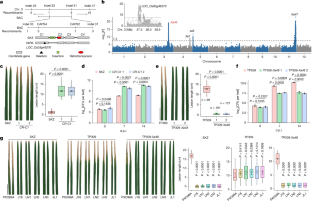
Artificial selection has greatly shaped crop agronomic traits1,2,3; however, the mechanistic basis of how immunity is selected remains unclear. Here we identify the Oryza sativa nucleotide-binding site and leucine-rich repeat (NLR) receptor XA48 and downstream transcription factors OsVOZ1 and OsVOZ2 (OsVOZ1/2), which confer resistance to bacterial blight. XA48 perceives the ancient pathogen effector XopG, activating effector-triggered immunity by degrading the negative regulator OsVOZ1/2. The XA48–OsVOZ1 module has undergone subspecies-specific selection: Xa48 is retained only in Oryza sativa indica and was lost in Oryza sativa japonica. By contrast, OsVOZ1 has diverged into two haplotypes—O. s. indica retains both OsVOZ1A/S alleles compatible with Xa48, whereas O. s. japonica has only OsVOZ1A. Reintroducing Xa48 into O. s. japonica severely compromises yield owing to the XA48–OsVOZ1A-mediated immune incompatibility. Stacking XA48-mediated effector-triggered immunity with XA21-mediated pattern-triggered immunity reconstitutes the broad-spectrum resistance from wild rice. Our study therefore reveals how asymmetric selection of an NLR–transcription factor module shapes disease resistance and reproducti