2026-07-30 日本原子力研究開発機構
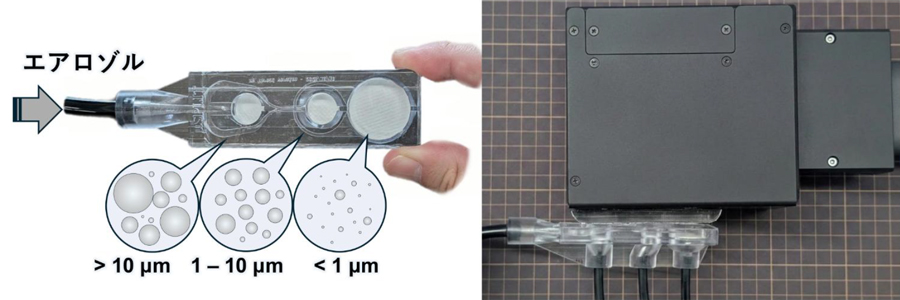
図1 使い捨て分級・計測デバイス「µSPLIT」
<関連情報>
- https://www.jaea.go.jp/02/press2026/p26073002/
- https://pubs.acs.org/acsodf/article/doi/10.1021/acsomega.6c04521/5215587/Development-of-a-3D-Printed-Two-Stage-Virtual
放射性エアロゾルの粒径分離と直接分析を実現する3Dプリント2段バーチャルインパクターの開発 Development of a 3D-Printed Two-Stage Virtual Impactor for Radioactive Aerosol Size Classification and Direct Analysis
Hugo Laffolley;Youichi Tsubota;Ayame Kuroe;Tomoaki Kato
ACS Omega Published:July 19, 2026
DOI:https://doi.org/10.1021/acsomega.6c04521
Abstract
Radioactive aerosol size classification is important for exposure assessment and decommissioning operations, particularly at the Fukushima Daiichi Nuclear Power Plant decommissioning site, where airborne particles may be generated or resuspended during remote inspection and debris retrieval. This study presents the development of a two-stage 3D-printed virtual impactor, called μSPLIT, designed to separate aerosols into three aerodynamic diameter classes (>10 μm, 1–10 μm, and <1 μm) while enabling direct postcollection analysis on integrated filters. The objective is to develop a virtual impactor that can be fabricated at a reduced cost and be disposed of easily after usage by incineration, without generating any hazardous human exposure during cleaning and decontamination activities, and free from metallic wastes that are not easily disposed of. The flow path was designed and optimized by computational fluid dynamics and Lagrangian particle tracking, and prototypes were fabricated by stereolithography. Numerical simulations predicted cutoff diameters of 9.0 and 1.3 μm for the first and second stages, respectively, with relatively sharp separation in both cases. The simulations also identified limitations of the current geometry, including small-particle contamination in the minor flow and large-particle contamination in the major flow of the second stage. Dimensional measurements of printed prototypes revealed contraction and corner rounding in the internal channels, confirming the need for fabrication compensation and quality control. Experimental tests with incense smoke provided a preliminary functional check, showing that submicrometric particles were mostly collected in the <1 μm particle class. Additional tests with Rn-progeny-bearing NaCl particles, characterized by a geometric mean aerodynamic diameter of 1.70 μm, produced the highest α activity on the middle filter (1–10 μm particle class), consistent with the expected classification. These results demonstrate the proof of concept of a lightweight and low-cost impactor for simultaneous aerosol size classification and direct radioactive particle analysis, while also identifying key areas requiring further optimization, particularly the second-stage geometry, quantitative wall loss assessment, and validation with standardized aerosols.