2026-04-15 中国科学院(CAS)
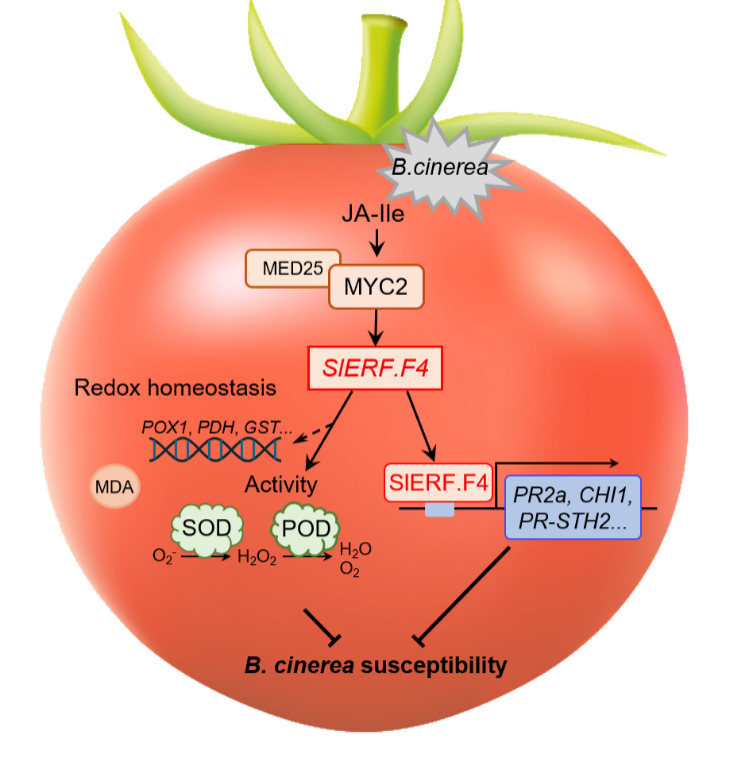
Schematic model of SlERF.F4-mediated defense against B. cinerea in tomato fruits (Image by WBG)
<関連情報>
- https://english.cas.cn/newsroom/research-news/202604/t20260415_1156328.shtml
- https://www.sciencedirect.com/science/article/pii/S0925521426001353
SlERF.F4は、成熟特性とは独立して、トマト果実の灰色かび病菌に対する感受性を負に制御する SlERF.F4 negatively regulates tomato fruit susceptibility to Botrytis cinerea independently of ripening traits
Yu Zhao, Pan Wu, Yulin Huang, Sumin Guo, Xiaofen Yu, Donald Grierson, Lei Gao, Shan Li
Postharvest Biology and Technology Available online: 6 March 2026
DOI:https://doi.org/10.1016/j.postharvbio.2026.114286
Highlights
- SlERF.F4 negatively regulates B. cinerea susceptibility per genetic evidence.
- SlERF.F4 reduces oxidative stress by increasing SOD/POD and decreasing MDA.
- SlERF.F4 directly activates PR2a and is itself bound and trans-activated by MYC2.
- SlERF.F4 exerts no effect on ripening and post-harvest fruit quality.
Abstract
Tomato fruits exhibit increased susceptibility to Botrytis cinerea infection during ripening. As a major fungal pathogen affecting tomato production, B. cinerea-induced disease responses are tightly regulated by Ethylene Response Factors (ERFs). SlERF.F4 is highly expressed in tomato fruits at the mature green stage and is strongly induced by B. cinerea infection. Compared with wild-type (WT) fruits, SlERF.F4 knockout (F4-KO) or knockdown (F4-RI) fruits displayed significantly enhanced susceptibility to B. cinerea, whereas SlERF.F4-overexpressing (F4-OE) fruits exhibited slightly reduced susceptibility. Enzymatic activities of superoxide dismutase (SOD) and peroxidase (POD) were decreased in F4-KO and F4-RI fruits but increased in F4-OE fruits relative to WT. In contrast, malondialdehyde (MDA) content showed the opposite trend, suggesting that SlERF.F4 may alleviate oxidative damage in fruits post B. cinerea infection. Genes encoding pathogenesis-related (PR) proteins, including PR2a, CHI1 and PR-STH2 were strongly induced in WT fruits upon B. cinerea infection but expression was impaired in F4-KO fruits, indicating that SlERF.F4 is required for this response. Further, SlERF.F4 could directly bind to the PR2a promoter and trans-activate its expression. Additionally, SlERF.F4 itself is a downstream target of MYC2 in the jasmonic acid (JA) signaling pathway. Notably, no significant differences were observed in days to ripening after anthesis, carotenoid content, firmness, soluble solids content, or postharvest water loss among F4-RI, F4-KO, F4-OE and WT fruits harvested at different ripening stages. In summary, SlERF.F4 induces oxidative-related responses and trans-activates PR gene expression to mitigate susceptibility to B. cinerea infection, without compromising fruit ripening and quality attributes.