2026-04-16 物質・材料研究機構
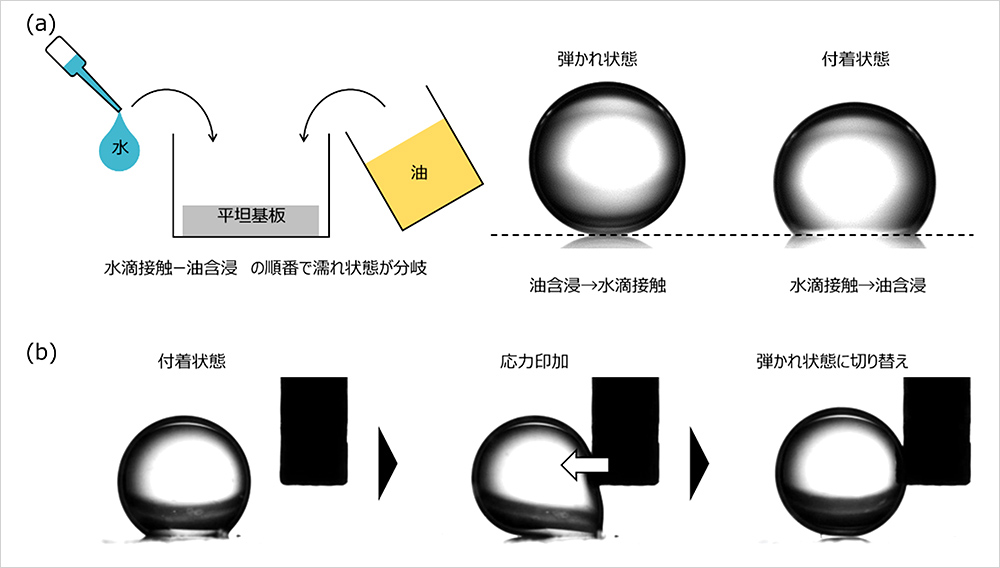
図: (a) 同一平坦基板上において、弾かれ・付着状態の水滴が同時に観察されている。弾かれ状態は、基板を油に沈めた後に水滴を接触させた状態。付着状態は水滴を接触させた後に油に沈めることで形成できる。
(b) 外部刺激による付着状態から弾かれ状態への切り替え。付着状態の水滴に対してテフロン針を用いて基板並行方向に応力を加えることで弾かれ状態に切り替えることができる。
<関連情報>
- https://www.nims.go.jp/press/2026/04/202604161.html
- https://www.nims.go.jp/press/2026/04/ln6cbk000000gr4p-att/202604161.pdf
- https://advanced.onlinelibrary.wiley.com/doi/10.1002/admi.70495
滑らかな表面における双安定濡れ状態 Bistable Wetting States on a Smooth Surface
Mizuki Tenjimbayashi, Shunto Arai
Advanced Materials Interfaces Published: 02 April 2026
DOI:https://doi.org/10.1002/admi.70495
ABSTRACT
Droplets on a non-textured surface typically exhibit a monostable wetting state, as represented by Young state. Here, we show that droplets can exhibit bistability without surface texture by tuning molecular interactions. We investigated the behavior of water droplets on a smooth substrate when immersed in oil. The oil contains hydrophilic interaction components, and their hydrophobic–hydrophilic balance was systematically varied. For oils with a specific hydrophobic–hydrophilic balance, droplet states bifurcate between repellent or sticky depending on the order of droplet casting and oil immersion. These states are neither transient nor one-off, indicating molecular interactions can create an energetic barrier separating the two states rather than surface textures. Under other oil conditions, the droplet remains monostable, either repellent or sticky, regardless of the order. This work advances the fundamental understanding of molecular effects on droplet behavior and expands surface design strategies in functional materials without compromising mechanical durability.