2026-08-24 中国科学院(CAS)
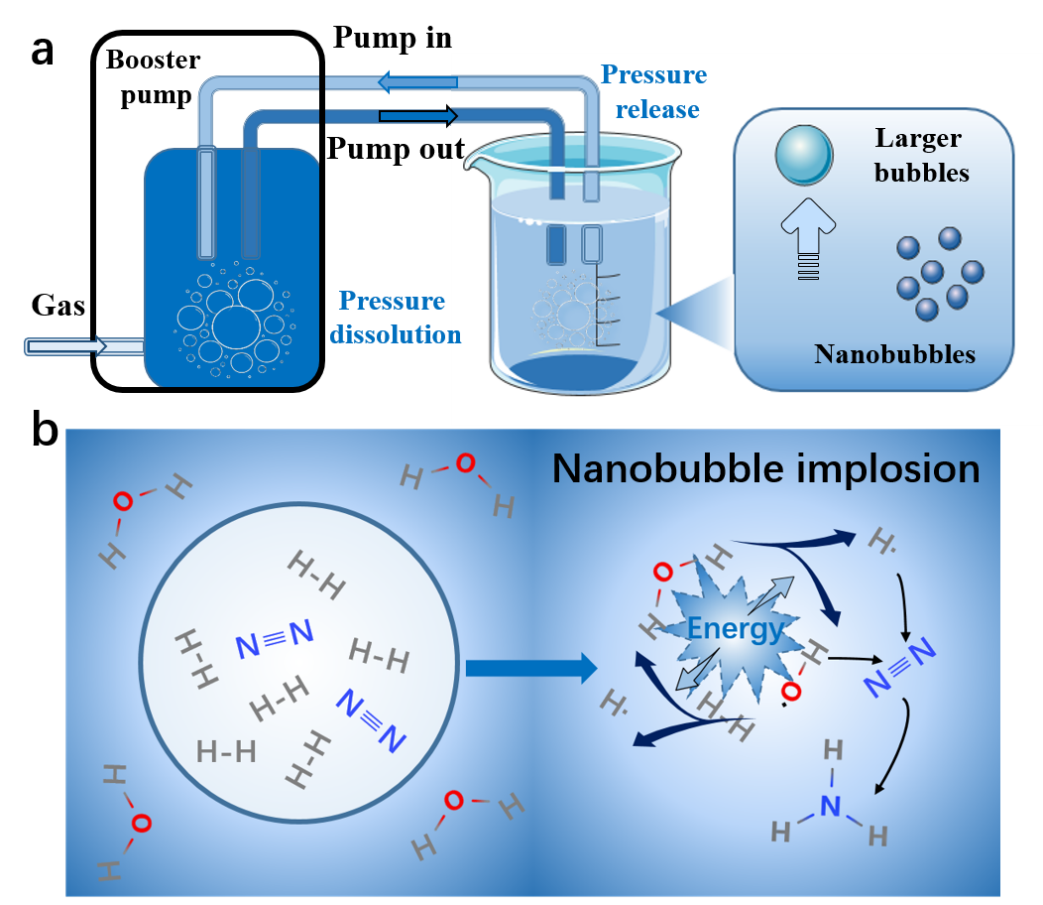
Scheme for nanobubble chemistry including both generation and implosion of the nanobubble in solution (Image from NCNST)
<関連情報>
- https://english.cas.cn/newsroom/research-news/202608/t20260824_1188763.shtml
- https://pubs.acs.org/jacsat/article-abstract/doi/10.1021/jacs.6c06081/5278533/Nanobubble-Radical-Driven-N2-Hydrogenation-for
ナノバブルラジカル駆動型N₂水素化による持続可能なアンモニア生産:穏やかな条件下でのハーバー・ボッシュ反応の代替法 Nanobubble Radical-Driven N2 Hydrogenation for Sustainable Ammonia Production: A Haber-Bosch Alternative under Mild Conditions
Shangkun Jin;Ruiyi Zhang;Lan Chen ;Guanglu Ge
Journal of the American Chemical Society Published:August 20, 2026
DOI:https://doi.org/10.1021/jacs.6c06081
Abstract
Ammonia is a cornerstone for global agriculture and promising renewable energy storage, yet its production through the conventional Haber-Bosch process accounts for nearly 2% of worldwide energy consumption, underscoring the urgent need for sustainable alternatives. Recent advances in interfacial chemistry, such as droplet-assisted reactions, have demonstrated unique reactivity in confined environments under mild conditions. However, many of these approaches rely on hydroxyl radicals and exhibit limited selectivity toward oxygen-free hydrogen-rich products like ammonia. Here, we report a catalyst-free nitrogen fixation strategy that achieves high ammonia selectivity (∼60%) using nanobubble-driven radical chemistry at ambient temperature and pressure. By harnessing the cavitation-decoupled N2/H2 nanobubbles collapsing in water, our system enables spontaneous nitrogen fixation with an optimized ammonia yield of ∼0.24 mg·L−1 achieved through 30 min nanobubble generation and subsequent 24 h standing, driven primarily by hydrogen radicals in a mechanism reminiscent of confined implosion. This collapse generates localized transient extremes of temperature and pressure, which promotes the formation of reactive hydrogen radicals. The high chemical potential of these radicals (∼2.3 eV) directly supplies the energy required for N≡N bond activation, eliminating the need for catalysts and external energy input. Beyond offering a scalable and energy-efficient route to green ammonia synthesis, this study provides mechanistic insight into prebiotic nitrogen-fixation pathways. The approach aligns with the global transition toward decentralized, low-carbon chemical production and contributes to a sustainable future for both energy and agriculture.