2026-08-11 中国科学院(CAS)
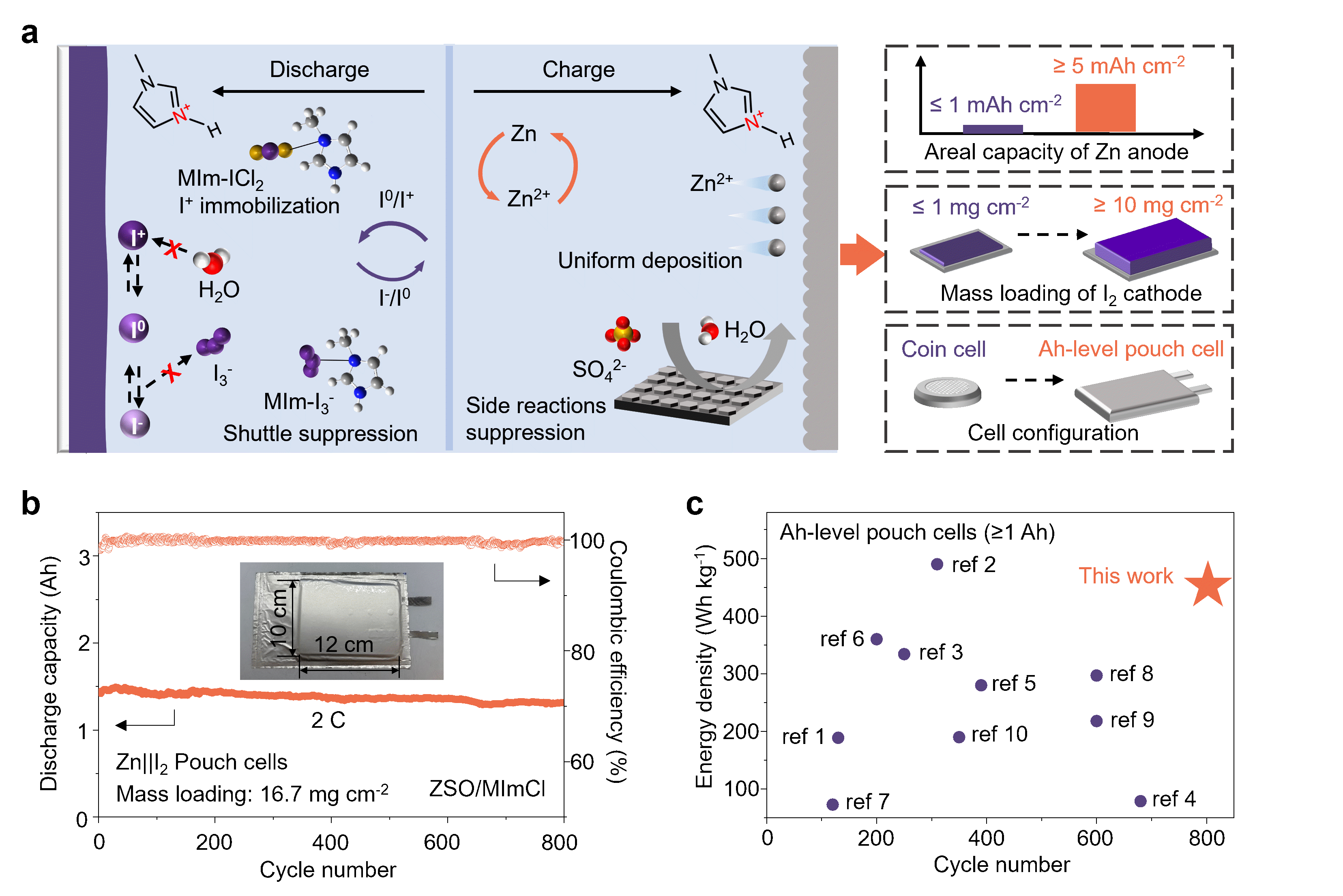
Dual-interface coordination orchestration strategy for Ah-level four-electron aqueous Zn||I2 pouch cells (Image by CHEN Yufeng and WANG Dongdong)
<関連情報>
- https://english.cas.cn/newsroom/research-news/202608/t20260811_1187809.shtml
- https://pubs.acs.org/jacsat/article-abstract/doi/10.1021/jacs.6c11308/5243340/Unveiling-Dual-Interface-Coordination
4電子化学を用いた耐久性のある水性亜鉛-ヨウ素パウチ電池のための二重界面配位オーケストレーションの解明 Unveiling Dual-Interface Coordination Orchestration for Durable Aqueous Zinc–Iodine Pouch Cells with Four-Electron Chemistry
Yufeng Chen;Renming Liu;Jiahui Hu;Dan Luo;Dongdong Wang;Zhongwei Chen
Journal American Chemical Society Published:August 04, 2026
DOI:https://doi.org/10.1021/jacs.6c11308
Abstract
Electrolyte additive engineering is regarded as an effective strategy for dual-interface optimization in four-electron aqueous zinc–iodine batteries (AZIBs). However, realizing durable Ah-level AZIBs with industrial-grade parameters (≥10 mg cm–2 I2 cathode mass loading, ≥5 mAh cm–2 Zn anode areal capacity) remains a significant hurdle. Here, we compare various nitrogen-containing cationic ligands to evaluate their synergistic regulation on iodine immobilization and Zn nucleation. This screening successfully establishes N-methylimidazolium chloride (MImCl) as a premier electrolyte additive for stabilizing dual-interface coordination. Upon discharging, the adsorption of MIm+ on the I2 cathode enables electrostatic binding with polyiodides and ICl2–. This interaction not only suppresses the polyiodide shuttle but also shields the I+ species from hydrolysis, promoting a robust and reversible four-electron I–/I0/I+ redox chemistry at elevated I2 mass loading. On the Zn anode, MIm+ preferentially adsorbs onto its surface during charging, accelerating Zn2+ deposition kinetics for dendrite suppression while passivating parasitic reactions, realizing uniform large-capacity Zn plating/stripping. As a result, the engineered 1.4 Ah four-electron Zn||I2 pouch cells achieve an excellent cyclability of 800 cycles and an ultrahigh cathode-mass-specific energy density of 455 Wh kg–1, surpassing most aqueous Zn-based systems in the Ah-class regime.