2026-06-25 中国科学院(CAS)
<関連情報>
- https://english.cas.cn/newsroom/research-news/202606/t20260625_1174857.shtml
- https://www.nature.com/articles/s41565-026-02184-3
単粒子触媒上での水酸化反応の空間イメージング Spatial imaging of water oxidation on single-particle catalysts
Wei Nie,Hong-Jia Wang,Yuying Gao,Deng Li,Yu Jin,Shisheng Zheng,Qian Li,Ziyuan Wang,Jian-Feng Li,Fengtao Fan & Can Li
Nature Nanotechnology Published:12 June 2026
DOI:https://doi.org/10.1038/s41565-026-02184-3
Abstract
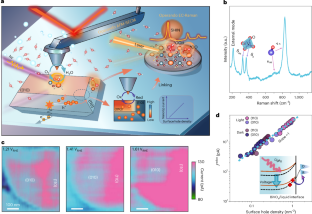
Water oxidation, widely recognized as the kinetic bottleneck of artificial photosynthesis, limits solar fuel efficiency. Despite progress in elucidating reaction mechanisms and theoretical predictions, the dynamic spatial coupling of charge transfer, localized structural motifs and active-site evolution remains unresolved, particularly as identified under operando conditions, obscuring key mechanistic pathways. Here, by integrating operando electrochemical shell-isolated nanoparticle-enhanced Raman spectroscopy with nanoscale electrochemical reaction imaging, we spatially resolve the atomic-scale interplay between hole transfer dynamics and the evolution of water oxidation intermediates that dictates the reaction kinetics on faceted BiVO4 particles. We show that dynamic structural adaption, mediated by multihole accumulation, governs the bifurcation of water oxidation pathways. At low surface hole densities (<0.67 nm−2), both (110) and (010) facets operate under single-hole transfer limitations, stabilizing hydroperoxo and peroxo intermediates, with the (110) facet evolving higher activity. On reaching a critical hole density threshold, the (010) facet evolves to be catalytically superior, exhibiting third-order power-law kinetics driven by the dynamic hole accumulation within Bi–O–V core structures via peroxo intermediates, whereas the (110) facet shifts to accumulate dual oxidizing equivalents, facilitating favourable intramolecular O–O coupling with higher energy demands. This work reveals water oxidation catalysis from static site-centric models to dynamic systems that are governed by hole-mediated structural adaptability, providing design principles for tailoring photocharge–catalyst architectures with atomic-scale precision for solar fuel generation.