2026-08-20 東京科学大学
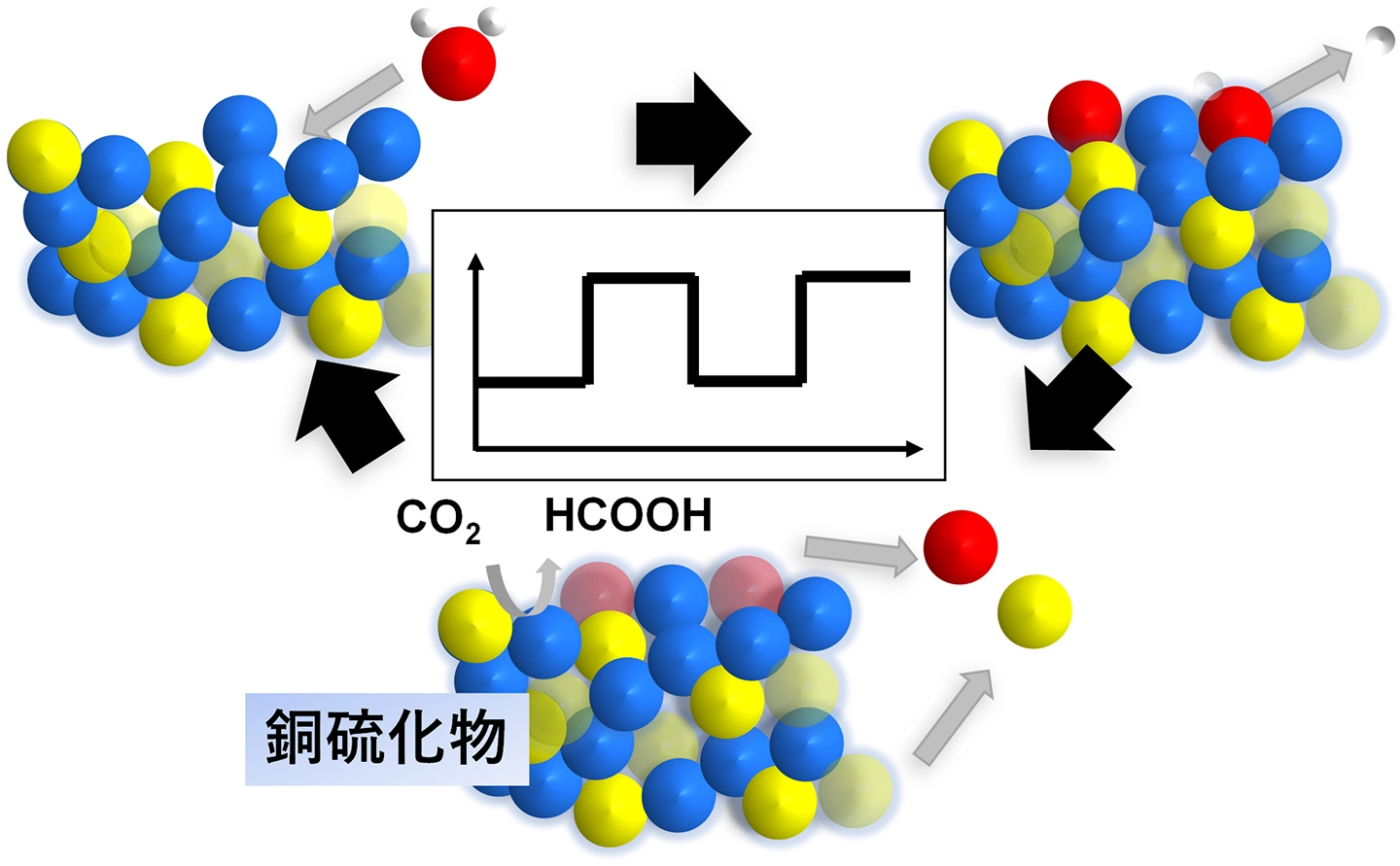
図1. 本研究で提案する触媒サイクル
<関連情報>
- https://www.isct.ac.jp/ja/news/l0uxpni9kz81
- https://pubs.rsc.org/ma/article/doi/10.1039/d6ma00736h/1291977/Investigation-of-the-role-of-the-anion-during
電位ステップ法を用いた硫化銅(CuS)上での電気化学的CO2還元 における アニオンの役割の調査
Investigation of the role of the anion during electrochemical CO2 reduction on copper sulfide (CuS) using the potential-step method
Akira Yamaguchi;Hisanobu Taga;Masahiro Miyauchi
Materials Advances Published:18 August 2026
DOI:https://doi.org/10.1039/d6ma00736h
The potential-step method is one of the promising approaches for electrochemical carbon dioxide (CO2) reduction because it can flexibly change the catalyst surface and control intermediate species, especially on metal sulfide catalysts. However, how potential modulation affects the catalyst surface state and reaction mechanism is still under discussion. Here, in this work, using copper sulfide (CuS) as a representative metal sulfide-based CO2 reduction electrocatalyst, the surface states of the catalyst were investigated to gain insight into the role of the anion during the potential-step method. X-ray diffraction patterns after anodic and cathodic application revealed that the cathodic potential generated Cu0 sites, while the subsequent anodic potential produced Cu2O by the introduction of OH− from the electrolyte. Additional cathodic potential re-reduced the Cu2O to close the catalytic cycle. In situ Fourier transform infrared spectroscopy and a CO2 reduction activity comparison among CuS, Cu0, Cu0 + S2−, and Cu2O clarified that bulk S stabilized the *CO intermediate to suppress further reaction, while surface-adsorbed S promoted *H supply to enhance the CO2 reduction activity. Furthermore, the presence of O on the surface promoted carbon–carbon bond formation. The results in this work show that each metal sulfide anion plays a specific role in controlling the selectivity of the electrochemical CO2 reduction product under potential-step conditions, bringing important insights for catalyst design.