2025-08-25 京都大学
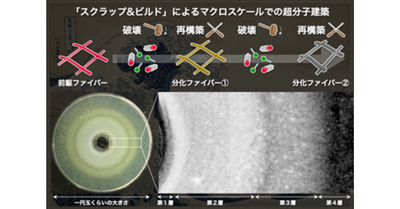
ファイバー構造の破壊と再構築からなる「スクラップ&ビルド」によるマクロスケールでの構造体形成 作成者:窪田亮(ハンマーとドライバーの絵はGoogle Gemini 3.5 Flash)。 背景の葛飾北斎の浮世絵:public domain, https://www.metmuseum.org/art/collection/search/39799から引用
<関連情報>
- https://www.t.kyoto-u.ac.jp/ja/research/topics/20260825
- https://www.nature.com/articles/s41467-026-76336-3
「壊して作る」非平衡自己組織化によって駆動される超分子形態転移 Supramolecular morphological transition driven by nonequilibrium break-and-build self-organisation
Ryou Kubota,Yuriki Ikuta,Shogo Torigoe,Naoki Kanazawa & Itaru Hamachi
Mature Communications Published:24 August 2026
DOI:https://doi.org/10.1038/s41467-026-76336-3
Abstract
Controlling the nonequilibrium dynamics in synthetic systems is an important challenge in supramolecular chemistry. Biological morphogenesis exploits nonequilibrium reaction–diffusion processes to organise differentiated cell networks and functions in space. In contrast, artificial assemblies are mostly formed under thermodynamic control, and they thus lack autonomous spatial complexity. Here, we present a supramolecular morphological transition that enables spatial control over the differentiation and decomposition of synthetic self-assembled fibres. Upon hybridisation with a surfactant, self-assembled fibres made from low-molecular-weight peptides undergo nonequilibrium break-and-build dynamics through cycles of fibre decomposition and reformation. Coupling these dynamics with surfactant diffusion generates repeated propagating waves that produce macroscopic nonlinear concentric patterns of chemically distinct fibres. These resultant patterns can be modulated by applying transient thermal pulses or by introducing multiple surfactants. This approach provides a strategy for the hierarchical organisation of supramolecular assemblies, opening up opportunities for constructing complex, functional soft materials with controlled spatial architectures.