2026-04-13 カリフォルニア大学サンディエゴ校(UCSD)
<関連情報>
- https://today.ucsd.edu/story/new-ai-approach-reveals-ocean-currents-in-unprecedented-detail
- https://www.nature.com/articles/s41561-026-01943-0
静止衛星から捉えた、これまでにない海洋潮流の観測 An unprecedented view of ocean currents from geostationary satellites
Luc Lenain,Kaushik Srinivasan,Roy Barkan & Nick Pizzo
Nature Geoscience Published:13 April 2026
DOI:https://doi.org/10.1038/s41561-026-01943-0
Abstract
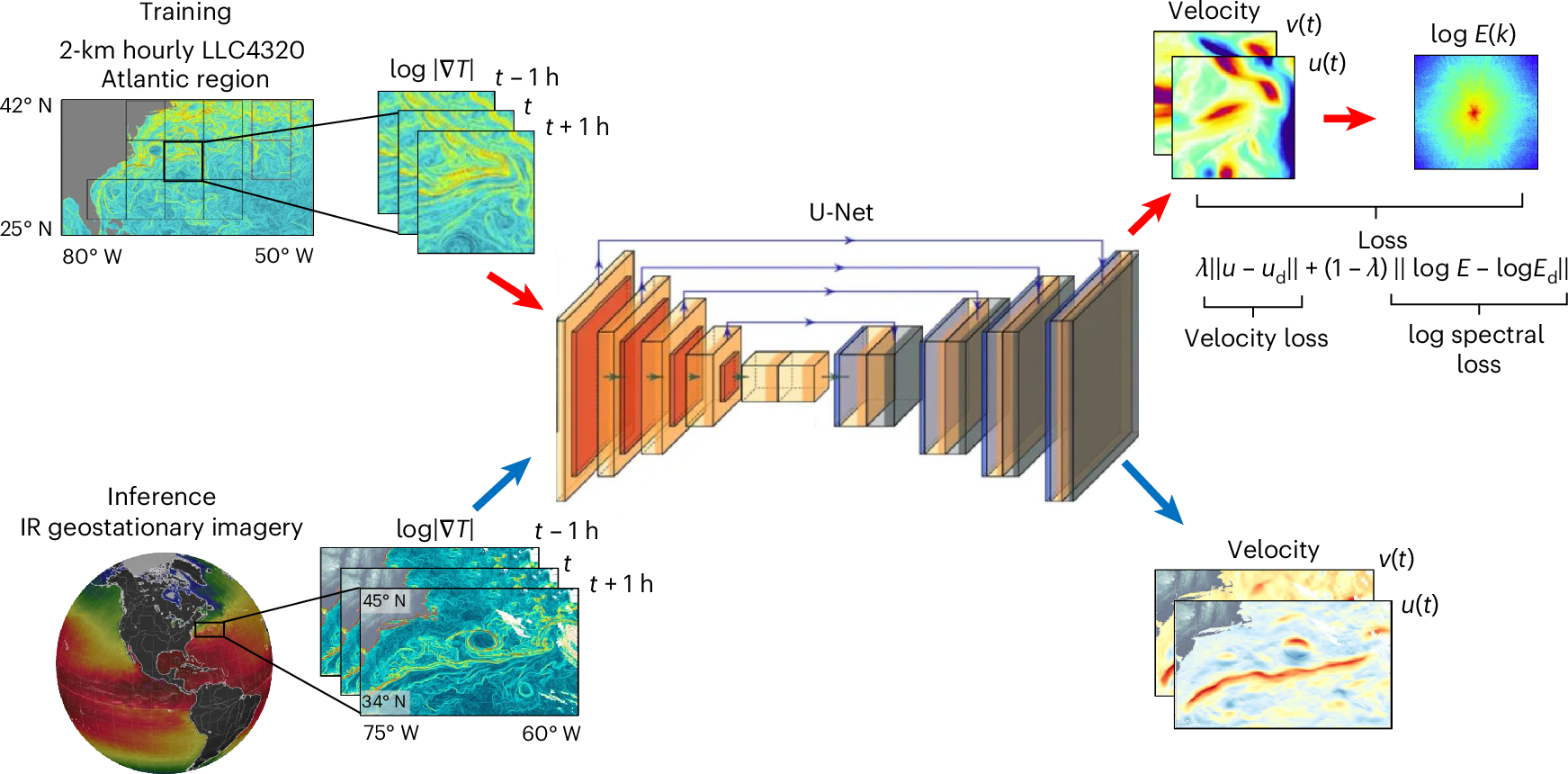
Oceanic submesoscale currents dominate the vertical exchanges of heat, biological nutrients and carbon between the shallow and the deep ocean and strongly influence the lateral dispersion of biogeochemical tracers and pollutants. Observing these surface intensified currents, however, has been a long-standing challenge due to their small scales and rapid evolution. Here we introduce Geostationary Ocean Flow (GOFLOW), a deep learning framework that takes advantage of geostationary satellites’ contiguous sequences of thermal imagery to produce hourly, high-resolution surface velocity fields that capture submesoscale circulations. Our approach does not assume simplified dynamical balances and inherently filters internal wave noise, both of which limit state-of-the-art satellite altimetry. Applying GOFLOW to the Gulf Stream, we provide satellite-based measurements of submesoscale current statistics, revealing characteristic asymmetries in vorticity and divergence previously documented only in high-resolution circulation models. This ability to routinely map the ocean’s energetic submesoscale currents provides a transformative data source to advance Earth system forecasting, to mitigate ocean pollution, to monitor marine ecosystems and to reduce climate model uncertainties.