2026-05-25 中国科学院(CAS)
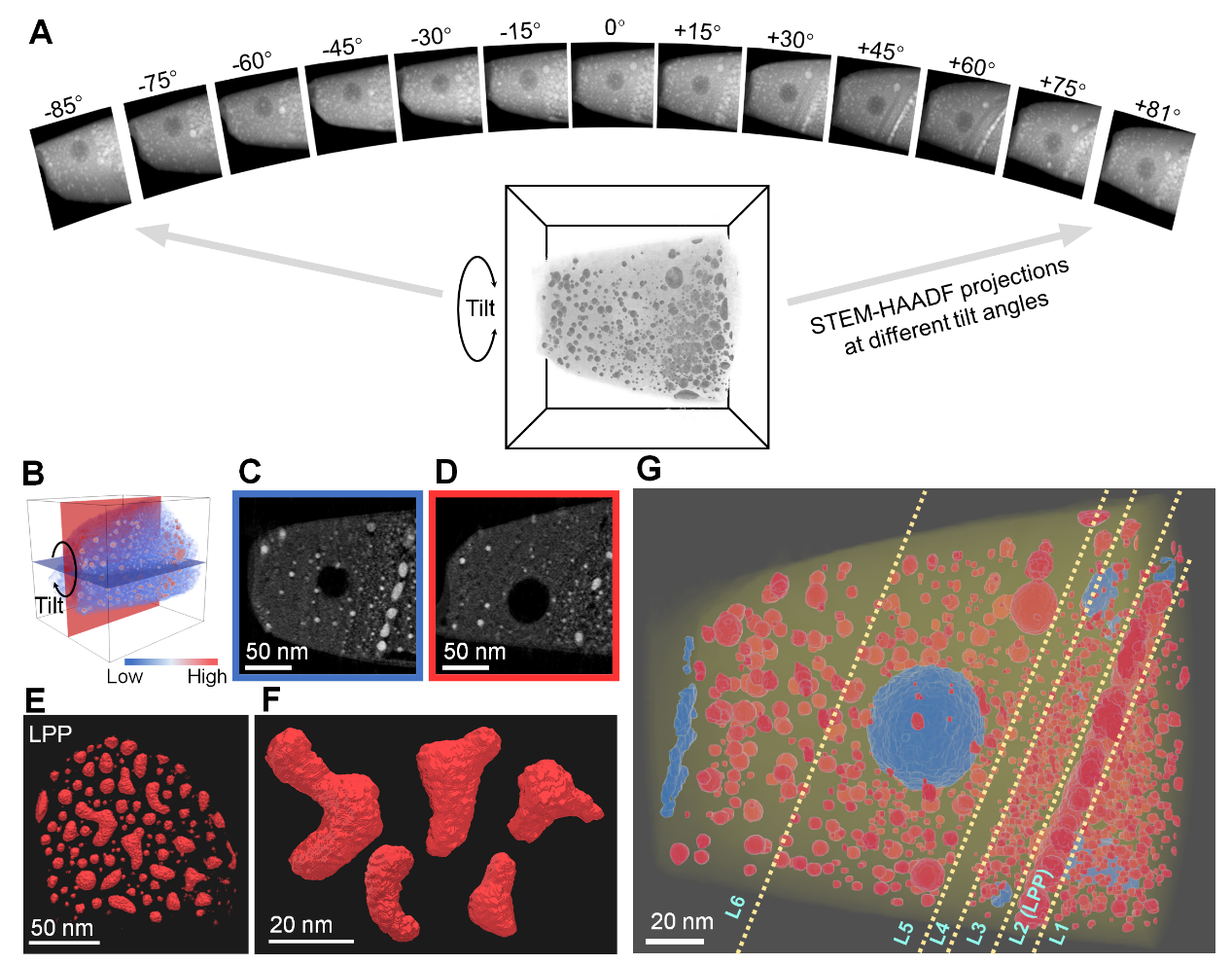
The schematic of ET experiment for tip samples and the 3D reconstruction results of Tomo-1. (Image by NIGPAS)
<関連情報>
- https://english.cas.cn/newsroom/research-news/202605/t20260526_1159898.shtml
- https://www.pnas.org/doi/10.1073/pnas.2528977123
- https://agupubs.onlinelibrary.wiley.com/doi/10.1029/2025JE009028
月面におけるナノ相Fe⁰の多起源に関する3D解析 3D insights into the multiorigins of nanophase Fe0 in the Moon surface
Yiheng Dai, Zezhou Li, Tianyi Jia, +4 , and Jihan Zhou
Proceedings of the national Academy of Sciences Published:May 26, 2026
DOI:https://doi.org/10.1073/pnas.2528977123
Significance
Nanophase metallic iron (npFe0) in lunar impact glass provides key information about the space weathering process. However, lack of three-dimensional structures and morphologies has hampered our understanding about the occurrence and formation mechanisms of npFe0. In this paper, we show multilayered structures containing various npFe0 sizes and densities by electron tomography and spectrum measurements. The results show the coexistence of multiple npFe0 origins in a very small region, and the high accumulation of Fe0 reaching up to 7.1 wt% within mature lunar impact glass.
Abstract
Nanophase metallic iron (npFe0) in lunar soils is a key indicator for understanding the space weathering mechanisms of airless bodies. However, the detailed three-dimensional (3D) spatial topology and distribution of layered npFe0 have rarely been documented in lunar soil samples. Here, we reveal the unique 3D spatial multilayered distributions and morphologies of npFe0 in the Chang’e-5 impact glass using a combination of electron tomography and spectroscopic techniques, demonstrating that npFe0 originates from multiple effects including iron sulfide decomposition, Fe(II) disproportionation, and solar wind irradiation. We provide direct evidence for the decomposition of iron sulfide to produce irregularly shaped npFe0. This study quantifies the 3D abundance of npFe0 in a piece of lunar impact glass, revealing localized Fe0 accumulation up to 7.1 wt%. Our results provide 3D nanoscale analysis for multiple coexisting formation mechanisms of npFe0, elucidating the complex space weathering processes in the lunar surface.
月面レゴリス中の共役ケイ酸塩ナノ液滴:衝突による相分離の解明 Conjugated Silicate Nanodroplets in Lunar Regolith: Unraveling Impact-Driven Phase Separation
Yiheng Dai, Zhiheng Xie, Zezhou Li, Tianyi Jia, Ruimin Wang, Zongjun Yin, Bing Shen, Jihan Zhou
Journal of Geophysical Research:Planets Published: 08 July 2025
DOI:https://doi.org/10.1029/2025JE009028
Abstract
Meteoroid impacts, a key process of space weathering, significantly alter the structures, compositions and properties of lunar regolith. However, the phase separation phenomena, common in lunar regolith and induced by impact, remain poorly understood. This uncertainty arises from the structural complexity and the scarcity of identified impact-induced phase separation features. Here we report the impact-induced formation of chemically distinct amorphous silicate nanodroplets, including iron-rich droplets within a silicon-rich glass matrix and vice versa, on the surface of a Chang’e-5 lunar regolith grain. These nanodroplets are partially ripened aggregates, and their formation is attributed to metastable liquid immiscibility driven by local chemical heterogeneities and rapid quenching. Additionally, troilite-kamacite remnants and skeletal crystallites of ilmenite and apatite provide direct evidence of impact and fast post-impact quenching, respectively. These findings suggest that quenched impact melts in airless bodies can undergo unmixing, forming immiscible conjugated nanodroplets, and exhibiting diverse behaviors under specific post-impact conditions.
Plain Language Summary
The Moon’s surface layer is continually modified by the impacts of meteoroids and micrometeoroids, altering its chemical composition and leading to the formation of characteristic structures. The behaviors of impact melts are not clearly resolved. Here we report on the chemically conjugated silicate nanodroplets discovered in the surface region of a Chang’e-5 lunar regolith grain. Remains of meteoroids and tiny mineral crystals are also found near these nanodroplets. These nanodroplets are clusters with unordered atomic arrangements, indicating the quick decrease in temperature. Based on their chemical compositions, we attribute their formation to the local variations in chemical makeup and rapid quenching after the impact event.