2026-10-28 オックスフォード大学
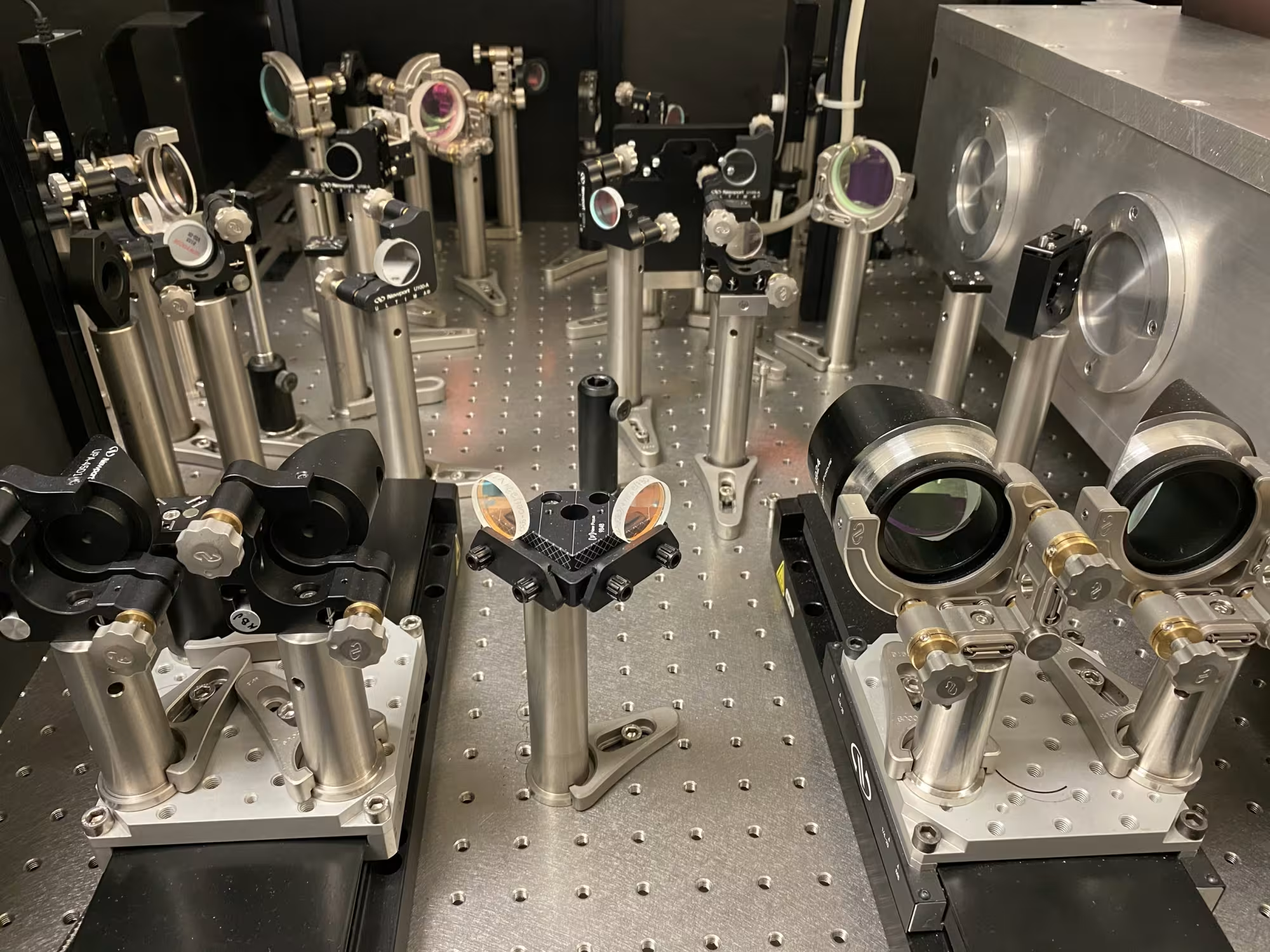
Non-contact optical probes of semiconductor performance. Credit: Laura Herz.
<関連情報>
- https://www.ox.ac.uk/news/2026-10-28-semiconductor-breakthrough-overcomes-major-challenge-in-capturing-solar-energy
- https://www.nature.com/articles/s41586-026-11223-x
擬似直接半導体における電子-正孔再結合の遅延 Delayed electron–hole recombination in a pseudo-direct semiconductor
Marcello Righetto, Debalina Banerjee, Zhenglin Jia, Joshua R. S. Lilly, Vincent J. -Y. Lim, Snigdha Lal, Siyu Yan, Jae Eun Lee, Jay B. Patel, Michael B. Johnston, Qianqian Lin, Marina R. Filip & Laura M. Herz
Nature Published:28 October 2026
DOI:https://doi.org/10.1038/s41586-026-11223-x
Abstract
Kirchhoff demonstrated the reciprocity between absorptivity and emissivity for blackbody radiation in 1860 (ref. 1), thereby establishing the general principle that a good absorber must also be a good emitter. This principle underpins the generalized Planck’s law2 and, when applied to semiconductors—in the form of the van Roosbroeck–Shockley equation3—results in substantial limitations to solar energy conversion. Here we demonstrate how this reciprocity can be circumvented in semiconductors, such as bismuth sulfide, showing a pseudo-direct bandgap character—that is, featuring a lower-energy indirect transition paired with a direct transition placed a few kBT above. After determining the pseudo-direct bandgap nature of bismuth sulfide, we reveal how this feature substantially retards bimolecular electron–hole recombination in this material with respect to classic direct semiconductors4. The resulting combination of a high absorption coefficient and delayed recombination offers the unprecedented possibility of overcoming limitations associated with Planck’s law, with far-reaching potential for solar energy conversion.