2026-10-28 中国科学院(CAS)
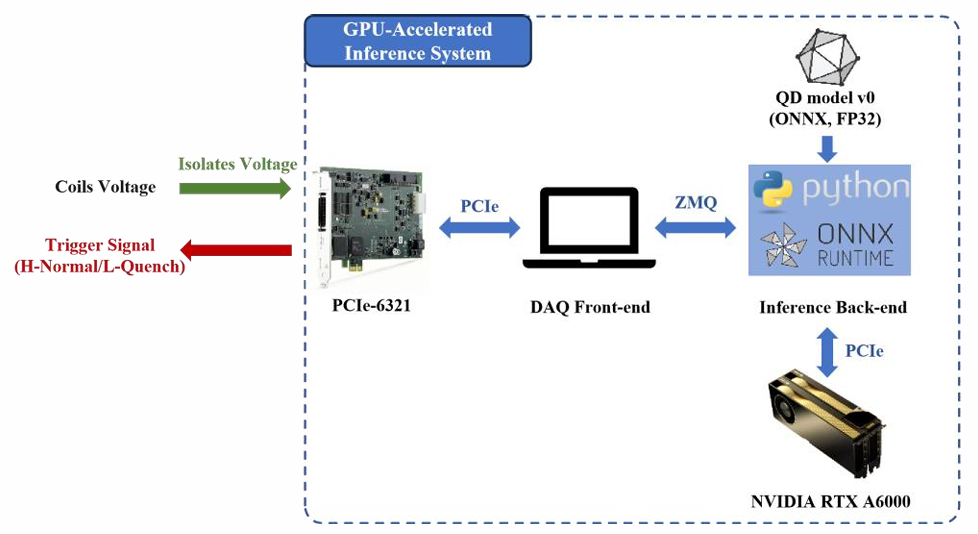
Artificial Intelligence Quench Detection System (AI-QDS). (Image from IMP)
<関連情報>
- https://english.cas.cn/newsroom/research-news/202610/t20261028_1212624.shtml
- https://iopscience.iop.org/article/10.1088/1361-6668/aeaf1c
複雑な電磁条件下における低温超伝導磁石のクエンチ検出のための深層学習に基づく手法 A deep learning–based quench detection method for LTS magnets under complex electromagnetic conditions
Zhenquan Liu, Xianjin Ou, Qinggao Yao, Xiang Zhang, Li’an Jin, Yujin Tong, Bin Li, Beimin Wu, Xudong Wang, Fei Wang
Superconductor Science and Technology Published: 14 October 2026
DOI:10.1088/1361-6668/aeaf1c
Abstract
The fourth-generation ECR ion source magnet (FECR), the CSR external-target experiment magnet (CEE), and other low-temperature superconductor (LTS) magnets developed at the Institute of Modern Physics and applied in accelerator facilities are subject to frequent voltage disturbances, such as those induced by flux jumps. These disturbances can closely resemble genuine quench signals, thereby posing a significant challenge to conventional parametric quench detection methods. To suppress false triggers, existing methods typically employ extended detection windows, which increase detection latency and reduce the available protection margin. To address this challenge, a deep learning–based quench detection method is proposed for LTS magnets operating under complex electromagnetic conditions. A dedicated neural network is developed to extract discriminative features from voltage signals and is deployed as an Artificial Intelligence Quench Detection System (AI-QDS) to enable real-time online quench detection. The system was further validated online during excitation tests of the HIAF-FECR superconducting magnet prototype No. 2 (HFECR-2#). During excitation toward the design current, three quench events occurred and were successfully detected online by the AI-QDS. Compared with a conventional parametric quench detection system, the proposed method reduced the detection latency by 9.6 ms, 32.0 ms, and 99.6 ms, respectively, while maintaining robust operation under strong electromagnetic disturbances. These results demonstrate the feasibility and effectiveness of deep learning–based online quench detection for LTS magnets. This method also provides a promising approach for intelligent protection of high-field Nb3Sn superconducting magnets and offers potential applications in future accelerator and fusion facilities.