2026-10-27 東京大学,理化学研究所,大阪大学,科学技術振興機構
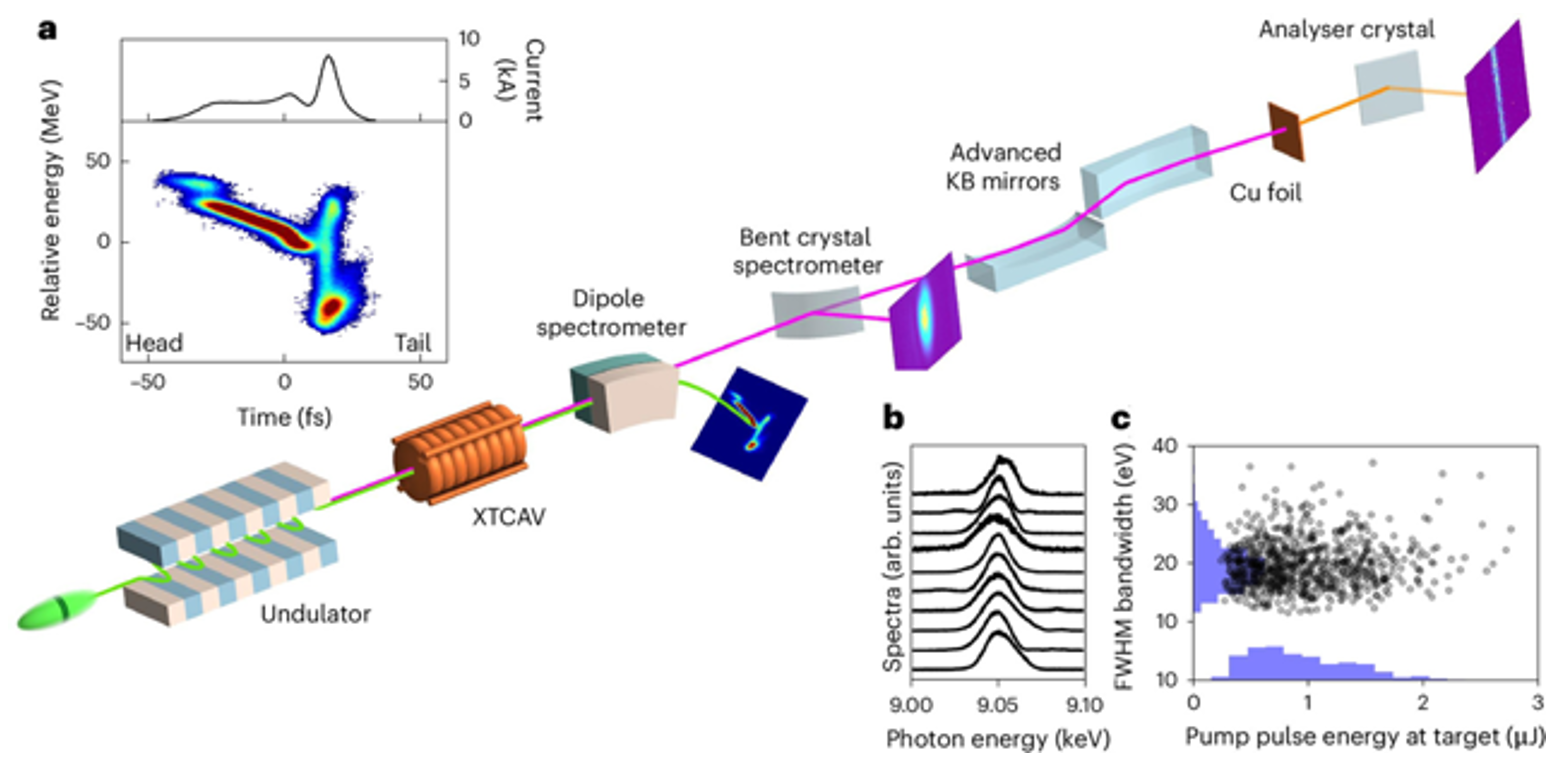
アト秒X線レーザーの時間幅の測定法のイメージ図
<関連情報>
- https://www.k.u-tokyo.ac.jp/information/category/press/0030860.html
- https://www.nature.com/articles/s41566-026-02026-7
アト秒硬X線パルスの実験的実証 Experimental demonstration of attosecond hard X-ray pulses
Ichiro Inoue, River Robles, Aliaksei Halavanau, Veronica Guo, Thomas M. Linker, Andrei Benediktovitch, Stasis Chuchurka, Matthew H. Seaberg, Yanwen Sun, Diling Zhu, David Cesar, Yuantao Ding, Vincent Esposito, Paris Franz, Nicholas S. Sudar, Zhen Zhang, Taito Osaka, Gota Yamaguchi, Yasuhisa Sano, Kazuto Yamauchi, Jumpei Yamada, Uwe Bergmann, Matthias F. Kling, Claudio Pellegrini, …Agostino Marinelli
Nature Photonics Published:20 October 2026
DOI:https://doi.org/10.1038/s41566-026-02026-7
Abstract
We present the experimental confirmation of attosecond pulse generation in the hard X-ray regime with a free-electron laser. Our experiment is based on the measurements of a nonlinear optical phenomenon known as amplified spontaneous emission from 3d transition metals. By analysing the yield of the collective X-ray fluorescence induced by ultrashort pulses at the Linac Coherent Light Source, we identify the generation of attosecond pulses and shot-to-shot fluctuations in their duration, ranging from 100 as to 400 as. The inferred time–bandwidth product for 100-as pulses is approximately 2 fs eV, indicating that a fraction of the pulses is nearly transform-limited pulses. Our results confirm the generation of attosecond hard X-ray pulses that can be used to simultaneously probe matter on the timescales of electronic phenomena and with atomic spatial resolution. Furthermore, attosecond hard X-ray pulses can outrun the fastest radiation damage processes, paving the way to single-shot damage-free X-ray measurements.