2026-10-27 カリフォルニア大学バークレー校(UCB)
<関連情報>
- https://news.berkeley.edu/2026/10/27/how-berkeley-researchers-decoded-the-loopy-physics-of-hula-hooping/
- https://link.springer.com/article/10.1007/s11071-026-13058-7
- https://royalsocietypublishing.org/rspa/article/480/2282/20230684/87252/Explorations-of-the-holonomy-of-a-rolling
- https://royalsocietypublishing.org/rspa/article/473/2200/20160770/79893/The-roles-of-impact-and-inertia-in-the-failure-of
フラフープの安定した動きを生み出す回転の交響曲:ネットワーク分析からの洞察 The symphony of gyrations producing steady motions of a hula hoop: insights from a network analysis
Chrystal Chern, Theresa E. Honein & Oliver M. O’Reilly
Nonlinear Dynamics Published:28 September 2026
DOI:https://doi.org/10.1007/s11071-026-13058-7
Abstract
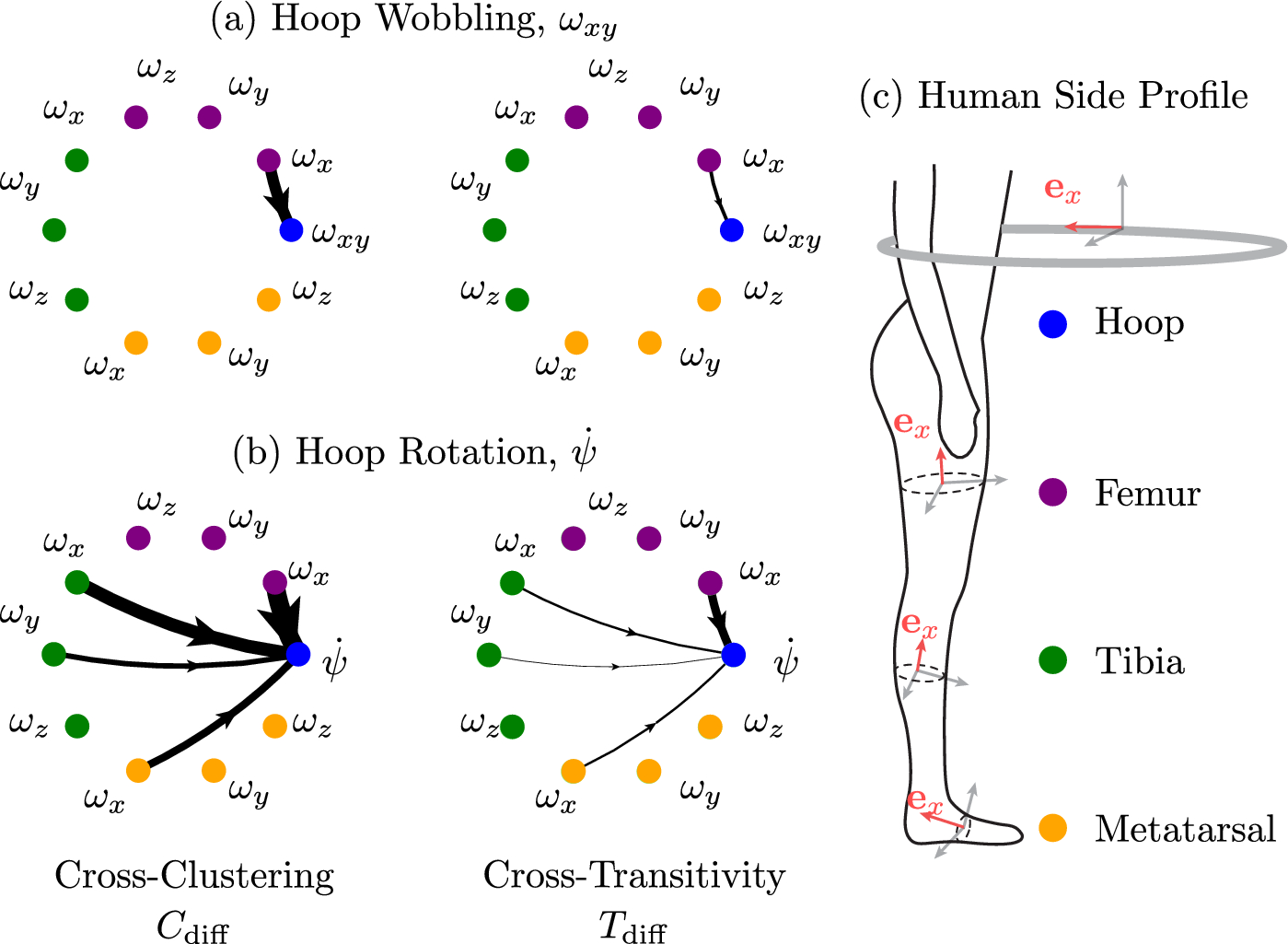
Hula hooping is a rhythmic activity where coordinated body movements induce a steady motion of the hoop. While a range of coordinated movements can successfully actuate the hoop, extracting the human motions that directionally influence this multi-harmonic symphony of gyrations and rotations is an open problem that we seek to answer. Our methods use motion tracking of the body and hoop along with a network analysis for a single set of coordinated motions to find that a specific rotation of the femur appears to influence the tilting motion of the hoop, while specific rotations of the femur, tibia, and metatarsal more strongly influence the whirling motion of the hoop. The conclusions from network analysis are shown to be superior to the results obtained from a principal component analysis and have application to human motion studies involving rehabilitation and assistive devices.
転がる球体のホロノミーの探求 Explorations of the holonomy of a rolling sphere
Theresa E. Honein; Oliver M. O’Reilly
Proceedings of the Royal Society A Published: 24 Jan 2024
DOI:https://doi.org/10.1098/rspa.2023.0684
Abstract
Consider a rigid body rolling with one point in contact with a fixed surface. Now suppose that the instantaneous point of contact traces out a closed path. As a demonstration of a phenomenon known as holonomy, the body will typically not return to its original orientation. The simplest demonstration of this phenomenon in rigid body dynamics occurs in the motion of a rolling sphere and finds application to path planning and reorientation of spherical robots. Motivated by earlier works of Bryant and Johnson, we establish expressions for the change in orientation of a rolling sphere after completing a rectangular path. We use numerical methods to show that all possible changes in orientation are possible using a single rectangular path. Based on the Euler angle parameterization of a rotation, we develop a more intuitive method to achieve a desired orientation using three rectangular paths. With regards to applications, the paths we discuss can be employed to achieve any desired reorientation of a spherical robot.
靴ひもの結び目の破損における衝撃と慣性の役割 The roles of impact and inertia in the failure of a shoelace knot
Christopher A. Daily-Diamond; Christine E. Gregg; Oliver M. O’Reilly
Proceedings of the Royal Society A Published:12 Apr 2017
DOI:https://doi.org/10.1098/rspa.2016.0770
Abstract
The accidental untying of a shoelace while walking often occurs without warning. In this paper, we discuss the series of events that lead to a shoelace knot becoming untied. First, the repeated impact of the shoe on the floor during walking serves to loosen the knot. Then, the whipping motions of the free ends of the laces caused by the leg swing produce slipping of the laces. This leads to eventual runaway untangling of the knot. As demonstrated using slow-motion video footage and a series of experiments, the failure of the knot happens in a matter of seconds, often without warning, and is catastrophic. The controlled experiments showed that increasing inertial effects of the swinging laces leads to increased rate of knot untying, that the directions of the impact and swing influence the rate of failure, and that the knot structure has a profound influence on a knot’s tendency to untie under cyclic impact loading.