

2026-10-27 大阪公立大学,国立環境研究所,九州大学,秋田県立大学,信州大学,森林総合研究所,北海道大学,東京農工大学,京都大学
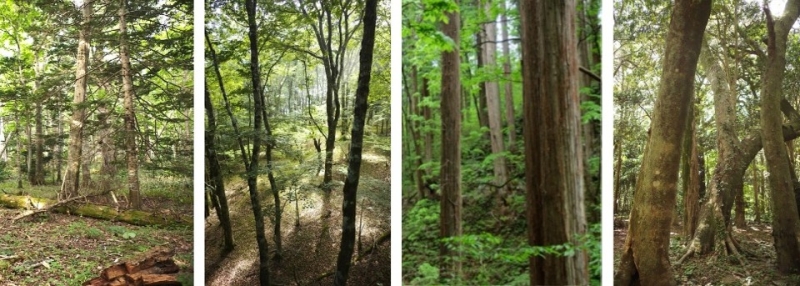
図1 日本列島で見られる4つの主要な森林バイオーム(写真:日浦 勉)
左より、北方針葉樹林・落葉広葉樹林・温帯針葉樹林・常緑広葉樹林
<関連情報>
- https://www.nies.go.jp/pr/news-and-updates/2026/press20261027.html
- https://www.sciencedirect.com/science/article/pii/S2197562026001090
長期モニタリングにより、日本の森林バイオーム構成における気候変動および撹乱に対する異なる反応が明らかになった Long-term monitoring reveals differential climate and disturbance responses in Japanese forest biome composition
Tetsuro Yoshikawa,Yayoi Takeuchi,Taku Kadoya,Tsutomu Enoki,Sakae Fujii,Atsuko S. Fukamachi,Mitsuru Hirota,Kazuhiko Hoshizaki,Naoki Iiyama,Yukio Ishikawa,Hiroki Itô,Hajime Kobayashi,Yasuo Konno,Hiroko Kurokawa,Akifumi Makita,Akira S. Mori,Dai Nagamatsu,Tohru Nakashizuka,Kanji Namikawa,Mahoko Noguchi…Tsutom Hiura
Forest Ecosystems Available online: 20 August 2026,
DOI:https://doi.org/10.1016/j.fecs.2026.100531
Abstract
Tree community responses to climate change differ markedly among biomes, and multiple interacting drivers complicate interpretation. This study investigated structural and compositional changes across major forest biomes (boreal conifers, deciduous broadleaved trees, temperate conifers, and evergreen broadleaved trees) using extensive spatial and temporal forest community data. The analyzed dataset included 191 plots across Japan, spanning decades since the 1950s and encompassing old-growth and secondary forest age classes. For each plot, biome types were classified, and changes in tree communities were quantified. Forest structural shifts were evaluated using the total basal area of all trees, four tree functional types, and dominant species. Compositional shifts were assessed based on the relative dominance of each functional type. Associations between these changes and climatic conditions, climate change trends, and other potential forest disturbance drivers were analyzed. Results showed that forest structure and functional composition changed across all biomes, with structural change significantly linked to climatic trends. Distinct response patterns to climatic variables emerged depending on biome and forest age. In old-growth forests, structural change rates were positively associated with the mean annual temperature change and negatively associated with the annual precipitation change. Structural change declined notably in southwestern regions with increased annual precipitation, likely due to intensified typhoon disturbance. Boreal conifer functional types declined markedly in relative dominance in old-growth forests and were replaced by deciduous broadleaved trees. Additionally, evergreen broadleaved types increased in some deciduous broadleaved old-growth forests. Overall, these findings align with thermophilization and indicate a broader, ongoing biome shift.
