2026-10-08 ミュンヘン大学(LMU)
<関連情報>
- https://www.lmu.de/en/newsroom/news-overview/news/artificial-intelligence-language-models-that-see-every-letter-2b3ace25.html
- https://www.nature.com/articles/s41586-026-11111-4
言語モデルをバイト単位で操作できるように改造する Retrofitting language models to operate over bytes
Benjamin Minixhofer, Tyler Murray, Tomasz Limisiewicz, Anna Korhonen, Luke Zettlemoyer, Noah A. Smith, Edoardo M. Ponti, Luca Soldaini & Valentin Hofmann
Nature Published:07 October 2026
DOI:https://doi.org/10.1038/s41586-026-11111-4
Abstract
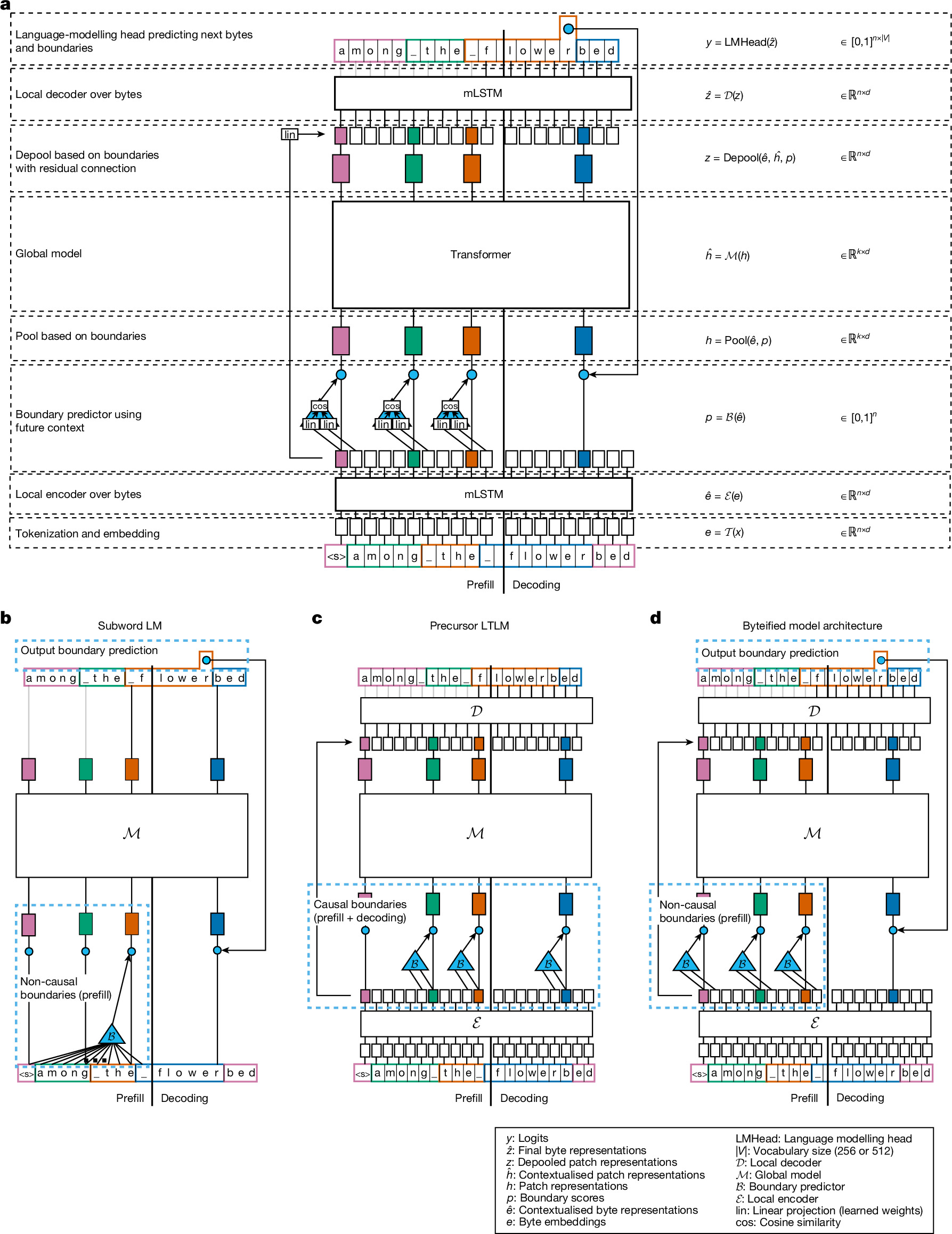
Recent advances in artificial intelligence (AI) have largely been driven by large language models, deep neural networks that operate over discrete units called tokens. To represent text, most large language models use words or word fragments as the tokens, known as subword tokenization1. Subword tokenization obscures fine-grained information, which is problematic, especially for scientific data—such as computer code or biological sequences—where meaning depends on the individual characters or bytes2. Models that instead operate directly on the byte encoding of text avoid these limitations, but until now they have lagged behind subword-based models in performance. Here we introduce a general method for creating byte-level large language models through byteification that approach the capabilities of subword-based systems. We use a two-stage conversion procedure to retrofit existing subword-based models into byte-level models with minimal extra training. The resulting models outperform earlier byte-level approaches and excel on character-level reasoning tasks, achieving practical inference speeds by efficiently processing byte-level information and adaptability by reusing the existing ecosystem around the source large language model. Our results remove a long-standing performance barrier to end-to-end byte-level language modelling, demonstrating that models operating on raw text encodings can scale competitively while offering advantages in domains requiring fine-grained textual understanding.