

2026-09-01 英国研究イノベーション機構(UKRI)
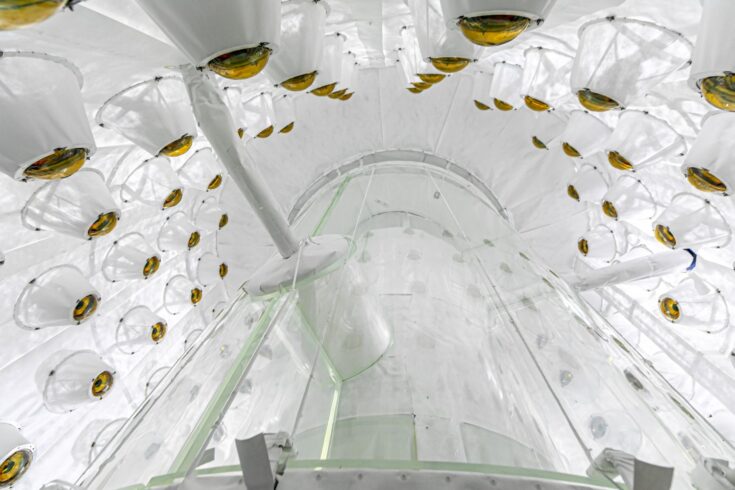
Looking up into the LZ outer detector, used to veto radioactivity that can mimic a dark matter signal. Credit: Matthew Kapust and Sanford Underground Research Laboratory
<関連情報>
- https://www.ukri.org/news/uk-led-analysis-behind-intriguing-dark-matter-results/
- https://lz.lbl.gov/wp-content/uploads/sites/6/2026/08/LZ_Preprint_260901_Dark_Matter_EFT_Nuclear_Recoil_Search_at_Higher_Energies.pdf
LUX-ZEPLIN(LZ)実験による、拡張された核反跳エネルギー範囲における暗黒物質粒子の相互作用の探索 Search for dark matter particle interactions in an extended nuclear recoil energy window with the LUX-ZEPLIN (LZ) experiment
D.S. Akerib,, A.K. Al Musalhi, B.J. Almquist, C.S. Amarasinghe, A. Ames,, T. Anderson, N. Angelides, H.M. Ara´ujo,, J.E. Armstrong, M. Arthurs,, A. Baker, S. Balashov, J. Bang, J.W. Bargemann, E.E. Barillier, D. Bauer, A. Beauchene, T.L. Benson, A. Bhatti, T.P. Biesiadzinski,, H.J. Birch, E. Bishop, G.M. Blockinger, B. Boxer, C.A.J. Brew, P. Br´as, S. Burdin, M.C. Carmona-Benitez, M. Carter, A. Chawla, J.J. Cherwinka, Y.T. Chin, S. Contreras, M.V. Converse, R. Coronel,, A. Cottle, C. Coulson, G. Cox, C.E. Dahl,, I. Darlington, S. Dave, J. Delgaudio, S. Desai, S. Dey, L. de Viveiros, L. Di Felice, C. Ding, J.E.Y. Dobson, E. Druszkiewicz, S. Dubey, C.L. Dunbar, S.R. Eriksen,, ∗ S. Fayer, N. Fieldhouse, S. Fiorucci, H. Flaecher, E.D. Fraser, T.M.A. Fruth, P.W. Gaemers,, R.J. Gaitskell, A. Geffre, J. Genovesi, C. Ghag, J. Ghamsari, A. Ghosh, S. Ghosh,, R. Gibbons,, S. Gokhale, J. Green, M.G.D.van der Grinten, J.J. Haiston, C.R. Hall, T. Hall, R.N. Hampp, S.J. Haselschwardt, M.A. Hernandez, S.A. Hertel, G.J. Homenides, M. Horn, T. Horoho, D.Q. Huang, W. Hulse, D. Hunt, E. Jacquet, R.S. James,,† K.R. Jenkins, A.C. Kaboth, A.C. Kamaha, D. Khaitan, A. Khazov, J. Kim, Y.D. Kim, D. Kodroff, Q.C. Kong, E.V. Korolkova, H. Kraus, S. Kravitz, L. Kreczko, V.A. Kudryavtsev, C. Lawes, E.B. Leon, D.S. Leonard, K.T. Lesko,, C. Levy, Z. Li,, J. Lin,, A. Lindote, W.H. Lippincott, J. Long, M.I. Lopes, W. Lorenzon, C. Lu, S. Luitz,, W. Ma, V. Mahajan, P.A. Majewski, A. Manalaysay, R.L. Mannino, R.J. Matheson, C. Maupin, M.E. McCarthy, D.N. McKinsey,, J. McLaughlin, J.B. McLaughlin, B. Mitra, E. Mizrachi,, M.E. Monzani,,, K. Mor˚a, E. Morrison, B.J. Mount, J. Munski, M. Murdy, A.St.J. Murphy, H.N. Nelson, F. Neves, A. Nguyen, C.L. O’Brien, F.H. O’Shea, I. Olcina,, K.C. Oliver-Mallory, J. Orpwood, K.Y Oyulmaz, K.J. Palladino, N.J. Pannifer, S.J. Patton, B. Penning, G. Pereira, R. Peres, E. Perry, T. Pershing, A. Piepke, S.S. Poudel, Y. Qie, J. Reichenbacher, G.R.C. Rischbieter,, E. Ritchey, H.S. Riyat, R. Rosero, N.J. Rowe, T. Rushton, D. Rynders, S. Salt˜ao, I. Sargeant, A.B.M.R. Sazzad,, R.W. Schnee, G. Sehr, B. Shafer, S. Shaw, L. Sherman,, K. Shi, T. Shutt,, C. Silva, G. Sinev, J. Siniscalco, A.M. Softley-Brown, V.N. Solovov, P. Sorensen, J. Soria,, T.J. Sumner, M. Szydagis, C.F. Tang, K. Thieme, D.R. Tiedt, D.R. Tovey, J. Tranter, M. Trask, K. Trengove, B. Twigg, A. Us´on, A.C. Vaitkus, O. Valentino, A. Wang,, J.J. Wang, Y. Wang,, L. Weeldreyer, T.J. Whitis, K. Wild, J. Winnicki, M.S. Witherell,, L. Wolf, F.L.H. Wolfs, S. Woodford, D. Woodward, Q. Xia, J. Xu, Y. Xu, M. Yeh, D. Yeum, J. Young, H.D. Zenger,, W. Zha, H. Zhang, T. Zhang, and Y. Zhou
2026 TeV Particle Astrophysics conference
We report on
We report on a search for dark matter particles interacting with xenon nuclei in an exposure of 2.84 tonne-years with the LUX-ZEPLIN (LZ) experiment. An extended nuclear recoil energy window up to approximately 270 keV enables searches for effective field theory and inelastic models of dark matter where high-energy recoils account for a larger fraction of the predicted recoil spectrum compared to the nominal spin independent interaction. We observe one event with characteristics consistent with a nuclear recoil of 248 ± 23(stat) ± 23(sys) keV, in a region where the known background expectation is low. A profile likelihood ratio test finds tension with the backgroundonly hypothesis at a global significance of 2.6σ when accounting for look-elsewhere effects, with a maximum local significance of 3.4σ across the models tested. We describe the analysis and event of interest, the background model used in the statistical inference, and detail several of the rare background topologies considered.

