
2021-04-22 国立天文台
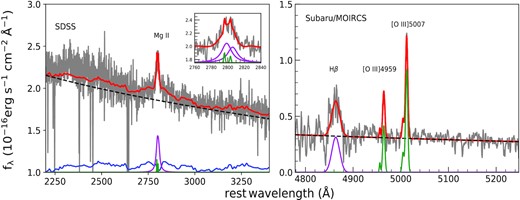
Figure 1.Spectrum of TXS 1206 + 549. Left: Mg ii line fit of the SDSS spectrum for MJD = 57430. The data (grey), best-fitting model (red) and power-law plus Balmer continuum (black dashed) are shown along with the decomposed broad (magenta) and narrow (green) components of Mg ii, and Fe ii in UV (blue). The inset plot shows the zoomed version of Mg ii line fitting. Right: H β model fit to the Subaru spectrum. The data (grey), best-fitting model (red), power-law continuum (black dashed), decomposed broad line (magenta) and narrow lines (green) are shown.
インド・日本・アメリカなどの研究者を中心とする国際研究チームは、すばる望遠鏡の赤外線観測装置 MOIRCS などを使った観測により、これまでで最も遠方にある、ガンマ線を放出する大変活動的な銀河を発見しました。ガンマ線放出銀河は、極めて強力な相対論的ジェットによって、高エネルギー帯域のガンマ線でも観測されます。特殊な種類の活動的な銀河で、これまでに 16 個しか見つかっていません。発見された銀河は約 90 億光年 (赤方偏移で 1.344) の距離 (注1) にあり、赤方偏移が1を超えるのは今回が初めてです。今回の発見を通して、今後さらに遠方の、すなわち宇宙の初期に現れたガンマ線放出銀河を探索するための道が開かれると期待されます。
詳細は、インド科学技術庁 (Department of Science & Technology) のプレスリリース記事 (英語) をご参照ください。
本研究成果は、英国天文学専門誌 Monthly Notices of the Royal Astronomical Society Letters (2021年3月27日付) に掲載されました (Rakshit et al. “TXS 1206 + 549: a new γ-ray-detected narrow-line Seyfert 1 galaxy at redshift 1.34?“)。
(注1) ここでは、光が天体を発してから私たちに届くまでに旅した距離 (光路距離) を示しています。すなわち、天体から出た光が 90 億年かけて地球に届いていることになります。遠い天体の距離の表記については、以下の国立天文台サイトをご参照ください。
遠い天体の距離について

