2026-07-21 京都大学
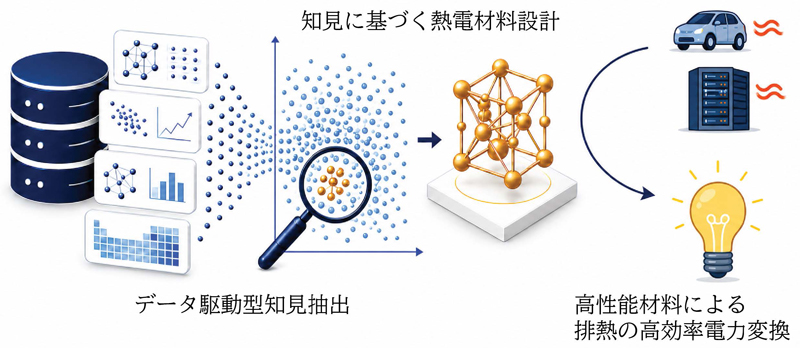
膨大な実験データからデータ解析で高性能材料の「目印」を抽出し、新しい熱電材料の設計につなげる。自動車やデータセンターなどの排熱の高効率な電力変換を目指す。(作成:孫一帆/画像生成:ChatGPT 5.6 Solを使用)
<関連情報>
- https://www.kyoto-u.ac.jp/ja/research-news/2026-07-21-1
- https://www.sciencedirect.com/science/article/pii/S2542529326001574
格⼦熱伝導率と全熱伝導率の⽐:データ駆動型熱電材料設計のための「フォノングラス・エレクトロンクリスタル」記述⼦ Lattice-to-total thermal conductivity ratio: A phonon-glass electron-crystal descriptor for data-driven thermoelectric design
Yifan Sun, Zhi Li, Tetsuya Imamura, Yuji Ohishi, Chris Wolverton, Ken Kurosaki
Materials Today Physics Available online: 15 July 2026
DOI:https://doi.org/10.1016/j.mtphys.2026.102166
Highlights
- Analyzed 71,913 experimental TE entries to quantify the PGEC paradigm from data.
- High-ZT materials cluster at lattice-to-total thermal conductivity ratio ≈ 0.5.
- Dual ML models predict kL and k to go beyond material screening into optimization.
Abstract
Thermoelectrics (TEs) are promising candidates for energy harvesting with performance quantified by figure of merit, ZT. To accelerate the discovery of high-ZT materials, efforts have focused on identifying compounds with low thermal conductivity . Using a curated dataset of 71,913 entries, we show that high-ZT materials reside not only in the low-K regime but also cluster near a lattice-to-total thermal conductivity ratio (kL/k) of approximately 0.5. This empirically derived ratio provides a quantitative descriptor for the well-known phonon-glass electron-crystal (PGEC) design concept. Building on this insight, we construct a framework consisting of two machine learning models for the lattice and electronic components of thermal conductivity that jointly provide both K and kL/k for screening and guiding the optimization of TE materials. By applying this framework to 104,567 inorganic compounds, we identify 2522 ultralow-k candidates while simultaneously evaluating their proximity to the PGEC regime. A follow-up case study on chemical doping demonstrates how the framework can qualitatively provide optimization strategies that shift pristine materials toward the empirical design target of kL/k ≈ 0.5 while maintaining their low total k. Ultimately, by integrating rapid screening with PGEC-guided optimization, our data-driven framework takes a critical step toward closing the gap between materials discovery and performance enhancement.