2026-07-21 大阪大学
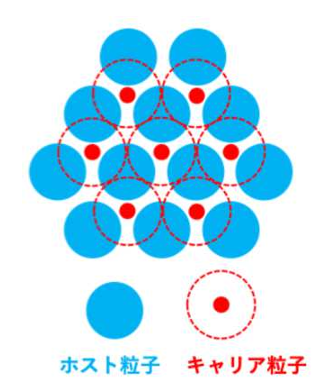
図1 超イオン伝導体における基本構造:ホスト粒子は強い立体斥力によって安定な結晶骨格を形成します。一方、キャリア粒子はホスト粒子の隙間に低密度で存在し、弱い遠距離相互作用(点線)によって低温では結晶構造を形成しますが、温度の上昇とともにホスト粒子に先駆けて融解します(副格子融解)。
<関連情報>
- https://www.d3c.osaka-u.ac.jp/2026/07/public-20260721/
- https://www.d3c.osaka-u.ac.jp/wp-content/uploads/2026/07/Press-Release-20260721.pdf
- https://www.pnas.org/doi/10.1073/pnas.2605867123
最小モデル超イオン伝導体における副格子融解を横断する非調和的かつ不均一なキャリアダイナミクスの調査 Probing anharmonic and heterogeneous carrier dynamics across sublattice melting in a minimal model superionic conductor
Sucharita Niyogi, Takenobu Nakamura, Genki Kobayashi, +1 , and Takeshi Kawasaki
Proceedings of the National Academy of Sciences Published:July 7, 2026
DOI:https://doi.org/10.1073/pnas.2605867123
Abstract
Despite decades of research, the microscopic origin of sublattice melting and fast ion transport in superionic conductors remains elusive. Here, we introduce a chemically neutral minimal binary model consisting of a rigid host lattice stabilized by short-range steric repulsion and a soft carrier sublattice interacting via long-range Wigner-type forces. This contrast naturally produces distinct melting temperatures and an intermediate sublattice-melting phase in which carriers become fluidlike while the host remains crystalline. Molecular dynamics simulations identify multiple dynamical regimes–crystalline, sublattice-melt, and fully molten–marked by sharp changes in diffusivity, structural correlations, and dynamical heterogeneity. Near sublattice melting, carrier motion is strongly anharmonic and spatially heterogeneous, beyond mean-field hopping descriptions. By tuning the density, we demonstrate that sublattice melting can be continuously controlled, establishing a direct link between lattice softness, anharmonicity, and collective ion transport. Comparison with conventional long-range Coulombic models confirms that our minimal model reproduces the key dynamical signatures of superionicity, providing a unified microscopic foundation for designing mechanically robust superionic conductors.