
2026-06-19 東北大学
東北大学多元物質科学研究所を中心とする国際共同研究グループは、水電解によるグリーン水素製造に用いる高性能触媒として、約1ナノメートルの「イリジウムナノクラスター(Ir15 NC)」を空気中で簡便かつ精密に合成する世界初の手法を開発した。従来、イリジウムナノクラスターは酸化されやすく、大気中での安定な合成が困難だったが、一酸化炭素(CO)とトリフェニルホスフィン(PPh3)を保護配位子として組み合わせることで、15個のイリジウム原子からなる高安定なナノクラスターの分離に成功した。
◆このナノクラスターを炭素支持体に担持して触媒化したところ、水電解の効率を左右する酸素発生反応(OER)において、市販のイリジウムナノ粒子触媒の約1.5倍の活性を示した。また、20時間以上の連続運転でも性能低下が見られず、高い耐久性も確認された。触媒粒子を極限まで微細化することで活性サイト密度を高め、希少で高価なイリジウムの使用量を大幅に削減できる点も大きな特徴である。本成果は、水素製造コストの低減やグリーン水素の普及を促進し、脱炭素社会の実現に貢献する重要な技術として期待される。
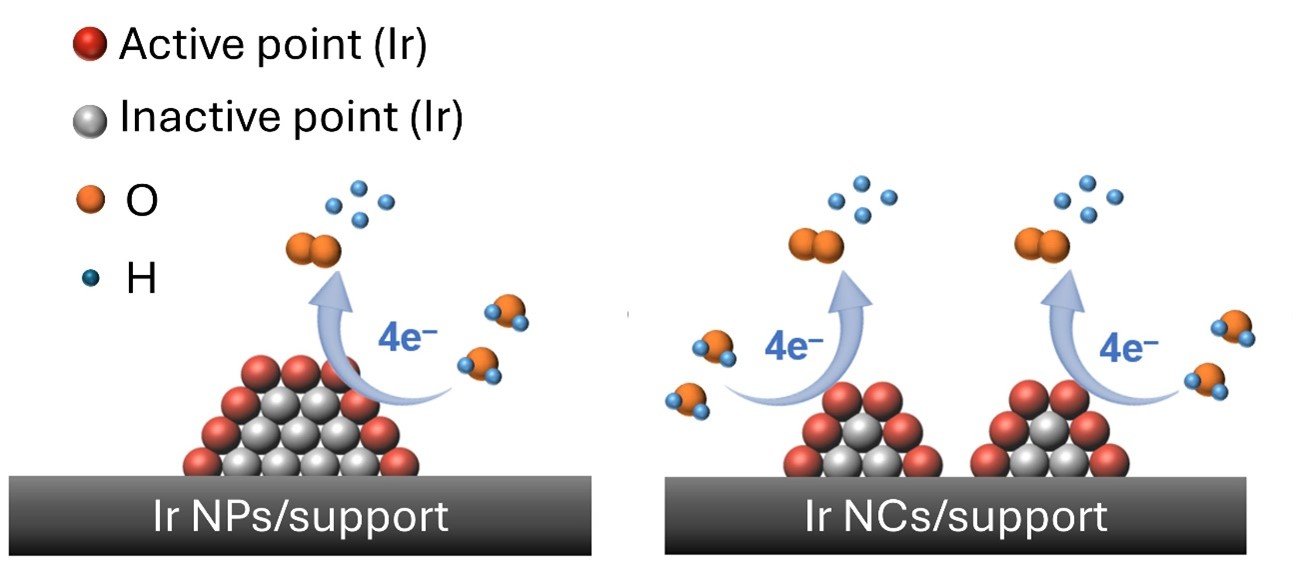
図1.水電解における酸素生成反応(OER)の反応スキーム。Ir粒子のサイズが小さくなるほど構成Ir原子の表面割合が増え、その活性が向上する。
<関連情報>
- https://www.tohoku.ac.jp/japanese/2026/06/press20260619-03-iridium.html
- https://pubs.acs.org/doi/10.1021/jacs.6c06563
約1 nmのイリジウムナノクラスターの精密合成による効率的な酸素発生触媒 Precise Synthesis of ∼1 nm Iridium Nanoclusters as a Catalyst for Efficient Oxygen Evolution
Tokuhisa Kawawaki,Kotaro Sato,Xiaolin Liu,Maho Kamiyama,Yamato Shingyouchi,Masaki Ogami,D. J. Osborn,Gregory F. Metha,De-en Jiang,and Yuichi Negishi
Journal of the American Chemistry Society Published: June 15, 2026
DOI:https://doi.org/10.1021/jacs.6c06563
Abstract
Metal nanoclusters (NCs) with a particle size of approximately 1 nm exhibit potential as highly active catalysts owing to their large specific surface areas and unique electronic structures. However, their precise synthesis in air is predominantly limited to coinage metal (Cu, Ag, and Au) NCs. Consequently, the development of a facile synthesis method for NCs composed of diverse metal elements is highly desirable. Accordingly, we focused on iridium (Ir), which is known for its high catalytic activity in numerous reactions. In this study, we established a precise synthesis method for air-stable Ir NCs and investigated their electrocatalytic activity in the oxygen evolution reaction (OER). We demonstrated that stable Ir∼15 NCs can be synthesized employing carbon monoxide and triphenylphosphine as stabilizing ligands. Furthermore, the OER catalysts derived from these Ir∼15 NCs as precursors exhibited a 1.5-fold increase in OER activity compared with commercially available Ir catalysts. These findings are anticipated to provide valuable design guidelines for the synthesis of NCs and the development of highly active electrocatalysts using a broad range of metal species.

