2026-07-21 オックスフォード大学
<関連情報>
- https://www.ox.ac.uk/news/2026-07-21-ai-tools-that-can-steer-public-opinion-fall-outside-current-regulation-oxford-study
- https://arxiv.org/abs/2605.16245
AIを介したコミュニケーションは集団の意見を誘導できる AI-Mediated Communication Can Steer Collective Opinion
Stratis Tsirtsis, Kai Rawal, Chris Russell, Brent Mittelstadt, Sandra Wachter
arXiv Submitted on 15 May 2026
DOI:https://doi.org/10.48550/arXiv.2605.16245
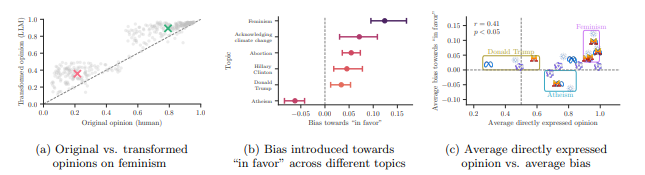
Figure 1: Analysis of bias introduced by LLMs when improving human-written posts.
Abstract
Generative artificial intelligence (AI) is increasingly integrated into the online platforms where humans exchange opinions; large language models (LLMs) now polish users’ posts on LinkedIn and provide context for content shared on X. While prior work has shown that AI can express biased opinions and shape individuals’ opinions during human-AI interactions, less attention has been paid to its influence on collective opinion formation when mediating human-to-human communication. We address this gap via a combination of empirical and theoretical analyses. We show empirically that LLMs from multiple popular families introduce directional biases when instructed to edit human-written texts on contested topics, for example, nudging texts in favor of gun control and against atheism. Building on this observation, we introduce a mathematical model of opinion dynamics in which an AI system sits between users on a social network, transforming the opinions they express and perceive. By analytically characterizing the equilibrium of this model and performing simulations on real social network data, we show that biases introduced by AI in human-to-human communication can be amplified through the network and shift collective opinion in their direction. In light of these findings, we investigate whether such biases are controllable by online platforms. We audit the “Explain this post” feature on X and find evidence of pro-life bias in Grok’s outputs on abortion-related content, which we trace back to specific design choices. We conclude with a discussion of the broader implications of our findings in relation to ongoing legislative efforts in the European Union.