2026-07-01 東北大学
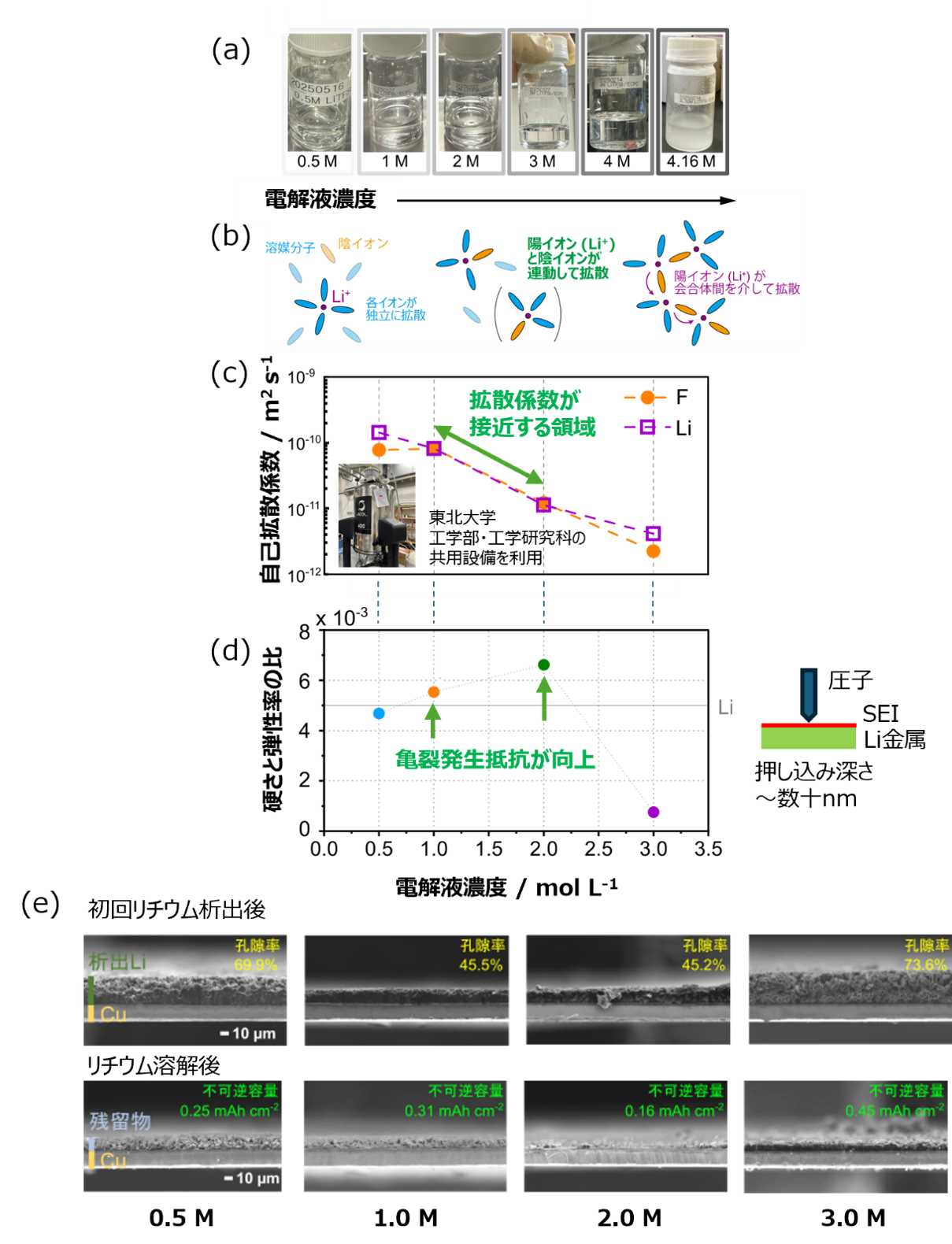
図1. 電解液濃度がイオン輸送、SEI形成、およびリチウム析出挙動に及ぼす影響。
<関連情報>
- https://www.tohoku.ac.jp/japanese/2026/07/press20260701-01-Lithium.html
- https://pubs.acs.org/doi/10.1021/acselectrochem.6c00140
イオン対拡散の相関により、リチウム金属負極におけるバランスのとれた輸送速度と界面安定性が実現する Correlated Ion-Pair Diffusion Enables Balanced Transport Kinetics and Interfacial Stability for Lithium Metal Anodes
Rongkang Jin,Hongyi Li,Mariko Ando,and Tetsu Ichitsubo
ACS Electrochemistry Published: June 29, 2026
DOI:https://doi.org/10.1021/acselectrochem.6c00140
Abstract
Determining the optimal electrolyte concentration for lithium metal anodes remains challenging due to the lack of clear design guidelines. Here, we systematically investigate the concentration-dependent lithium deposition and dissolution behavior in electrolytes composed of lithium bis(trifluoromethanesulfonyl)imide (LiTFSI) and a mixed solvent of equi-volumetric ethylene carbonate (EC) and propylene carbonate (PC). As the concentration increases toward saturation (∼4.16 M), Li+ ions increasingly coordinate with TFSI− anions. Notably, comparable diffusion coefficients of Li+ and TFSI− are observed at intermediate concentrations (1−2 M), indicating correlated ion-pair diffusion. This regime coincides with dense lithium deposition, low overpotentials, and high coulombic efficiency compared with both lower and higher concentrations. Analysis of the solid-electrolyte interphase (SEI) reveals that at low concentration (∼0.5 M), the SEI exhibits a low fluorine-to-oxygen ratio, leading to sluggish interfacial charge transfer and low mechanical strength. At high concentration (∼3 M), a fluorine-rich SEI facilitates interfacial charge transfer and increases the elastic modulus. However, the resulting highly stiff SEI promotes the incorporation of SEI components into the deposits and increases ohmic resistance, suggesting hindered electron transport within the bulk deposits. In contrast, the SEI formed at intermediate concentration (1−2 M) achieves a balance between transport kinetics and mechanical robustness, as reflected by an increased hardness to elastic modulus (H/E) ratio. These findings provide a unified understanding of concentration effects and offer general design principles for optimizing electrolytes for lithium metal anodes.