2026-06-12 清華大学
◆研究チームは「α水素除去」分子設計戦略を提案し、カルボン酸エステル系溶媒が高電圧正極上でα位酸化により分解することを解明したうえで、反応性の高いα水素をメチル基に置換して分解経路を遮断した。開発したMTMAはフッ素原子を用いずに5.6V(vs. Li/Li⁺)までの高い酸化安定性を示し、従来のフッ素系電解液LB372の4.9Vを大きく上回った。さらに7.2Ahパウチセルでは652.4Wh/kgのエネルギー密度を達成し、28サイクル後も94.5%の容量維持率を示した。eVTOL用途を想定した高出力条件でも5.0Ahセルが350サイクル以上安定動作し、実機試験ではクアッドコプターの離陸・ホバリング・着陸を成功させた。環境負荷低減と高性能化を両立する次世代電池技術として期待される。
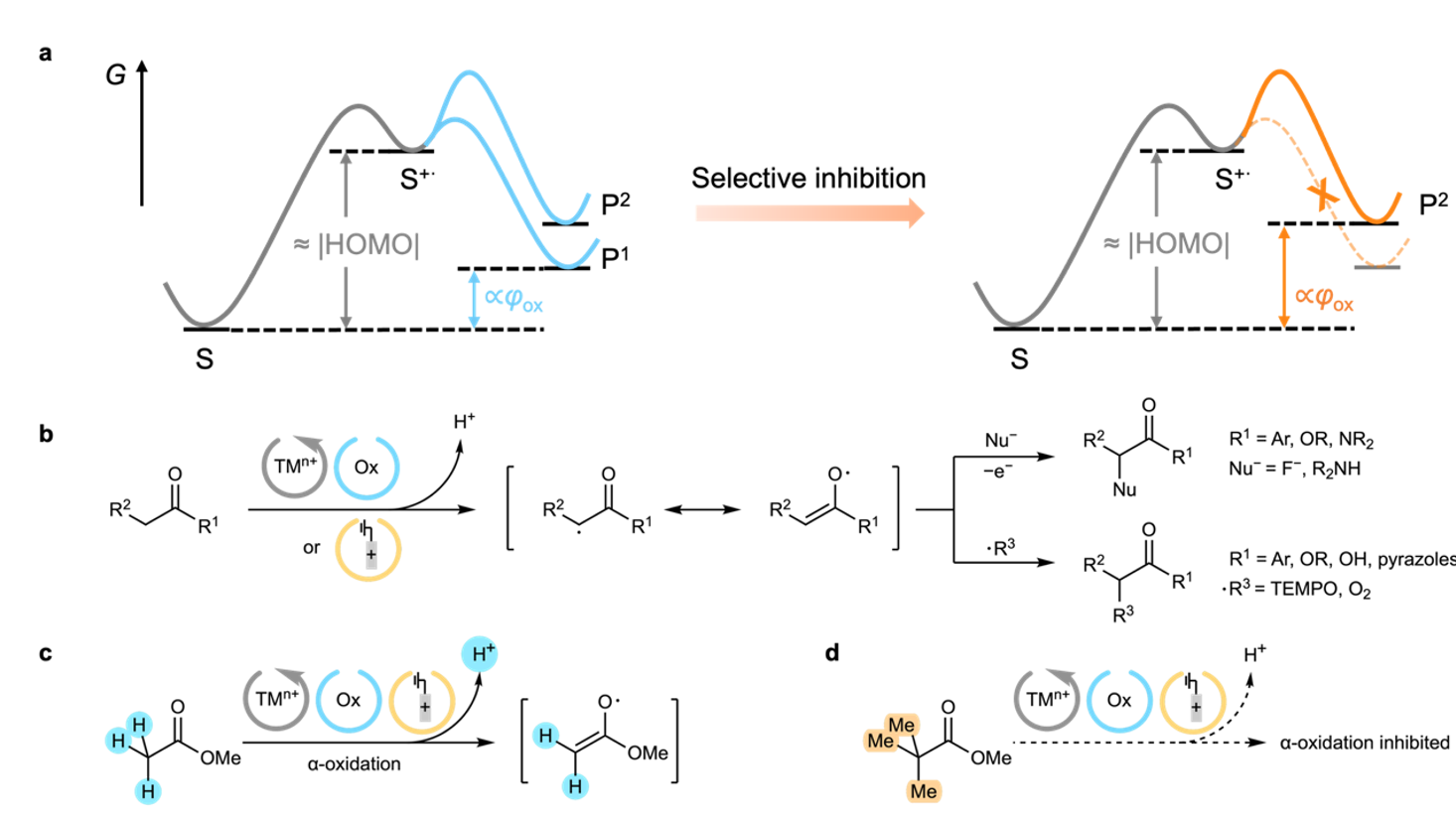
Figure 1. Fluorine-free, high-voltage-stable molecular design strategy. (a) Enhancing oxidative stability by blocking the optimal oxidation pathway; (b) Common oxidation mechanisms of carboxylate esters; (c) The α-oxidation mechanism of conventional carboxylate esters; (d) The blocked α-oxidation pathway of the MTMA solvent.
<関連情報>
- https://www.tsinghua.edu.cn/en/info/1245/14949.htm
- https://www.nature.com/articles/s41557-026-02161-2
α水素の酸化を阻害することで、フッ素化されていない溶媒でもリチウム電池において高い安定性を実現できる Blocking oxidation of α-hydrogens enables non-fluorinated solvents to achieve high-potential stability in lithium batteries
Yu-Xin Huang (黄宇欣),Yi Yang (杨毅),Chen-Zi Zhao (赵辰孜),Pan Xu (徐攀),Zi-Yue Jiang (蒋子悦),Zi-Zhang Qiu (邱子彰),Xing-Yu Zhong (仲星宇),Zong-Yao Shuang (双宗尧),Xue-Yan Huang (黄雪妍),Yong-Feng Li (李永丰),Wei-Jin Kong (孔伟进),Yi-Fan Tan (谈逸凡),Xiang Chen (陈翔),Kaihang Zhang (张凯航),Jia-Qi Huang (黄佳琦) & Qiang Zhang (张强)
Nature Chemistry Published:26 May 2026
DOI:https://doi.org/10.1038/s41557-026-02161-2
Abstract
Developing next-generation batteries that are high-energy, low-cost and eco-friendly is crucial for industrial applications. Lithium-rich manganese-based oxide positive electrodes offer substantial specific energy, enabled by their high specific capacity at high charging potential (>4.6 V versus Li/Li+). However, stable operation at such high potentials remains challenging, as most electrolytes rely on environmentally unfriendly fluorinated solvents. Here we identified α-oxidation of the carbonyl group as the main oxidation mechanism of carboxylate esters. By removing all the reactive α-hydrogens of methyl acetate, we demonstrate that methyl trimethylacetate is a non-fluorinated, high-potential-stable solvent. This solvent exhibits outstanding oxidative stability up to 5.6 V versus Li/Li+, and electrochemical cells using methyl-trimethylacetate-based electrolytes maintain stable cycling at 4.6/4.7 V, outperforming many fluorinated systems. An industrial-scale 7.2-Ah pouch cell reached a maximum specific energy of 652.4 Wh kg−1 with 94.5% capacity retention after 28 cycles at 0.1 C/0.2 C. This work provides a simple molecular design strategy that addresses specific energy, cost and sustainability in next-generation high-voltage lithium batteries.