2026-07-13 東京大学
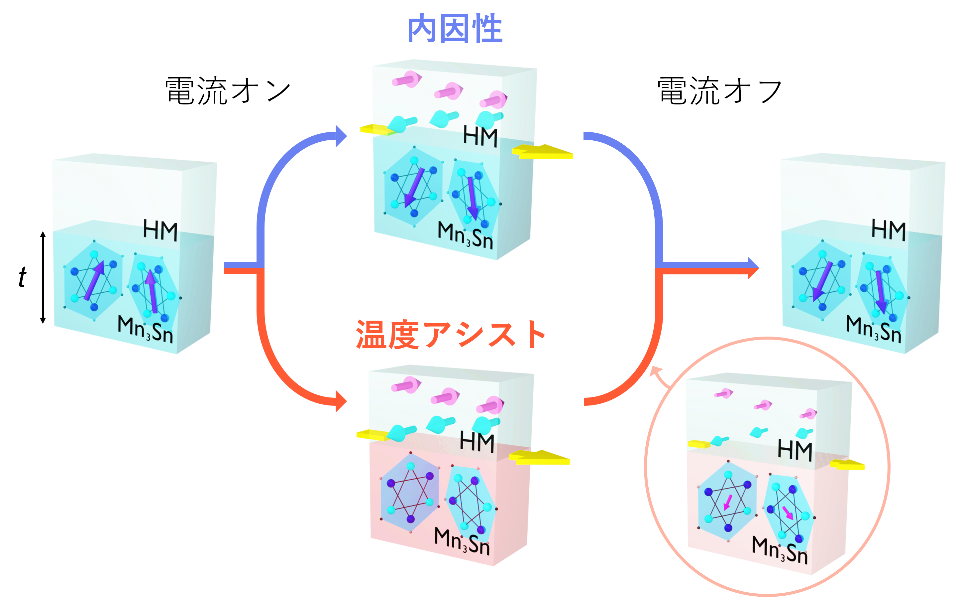
Mn3Sn/重金属(HM)素子におけるスピン流を用いた二つの磁気スイッチング機構。内因性機構によるスイッチングでは電流印加時にスピン流が磁気秩序に直接作用するのに対し、温度アシスト機構によるスイッチングでは電流印加中に磁性秩序が失われる。
<関連情報>
反強磁性秩序のスピン軌道トルクスイッチングにおける固有領域と温度アシスト領域間のクロスオーバー Crossover between intrinsic and temperature-assisted regimes in spin-orbit torque switching of antiferromagnetic order
Takumi Matsuo,Tomoya Higo,Hanshen Tsai,Daisuke Nishio-Hamane,Takuya Matsuda,Ryota Uesugi,Kouta Kondou,Shinji Miwa,Yoshichika Otani & Satoru Nakatsuji
Nature Communications Published:13 July 2026
DOI:https://doi.org/10.1038/s41467-026-74311-6
Abstract
Intensive studies have been made on antiferromagnets as candidate materials for next-generation memory bits due to their ultrafast dynamics reaching picosecond time scales. Recent demonstrations of electrical bidirectional switching of antiferromagnetic states have attracted significant attention. However, in the presence of significant Joule heating that destabilizes the magnetic order, the timescales associated with the switching can be limited to nanoseconds or longer. Here, we present the observation of a crossover in the switching behavior of the chiral antiferromagnet Mn3Sn by tuning the magnetic layer thickness. While Joule heating interferes with switching in thicker devices, we find clear signatures of an intrinsic spin-orbit torque mechanism as the thickness is reduced, avoiding the heating effect. The suppression of heating enables switching without significant attenuation of the readout signal using pulses shorter than those required by temperature-assisted mechanisms. The crossover into the spin-orbit torque switching behavior clarifies the potential for achieving ultrafast switching as expected from the picosecond spin dynamics of antiferromagnets. Our results lay the groundwork for designing antiferromagnetic memory devices that can operate at ultrafast timescales.