2026-07-13 ペンシルベニア州立大学(PennState)
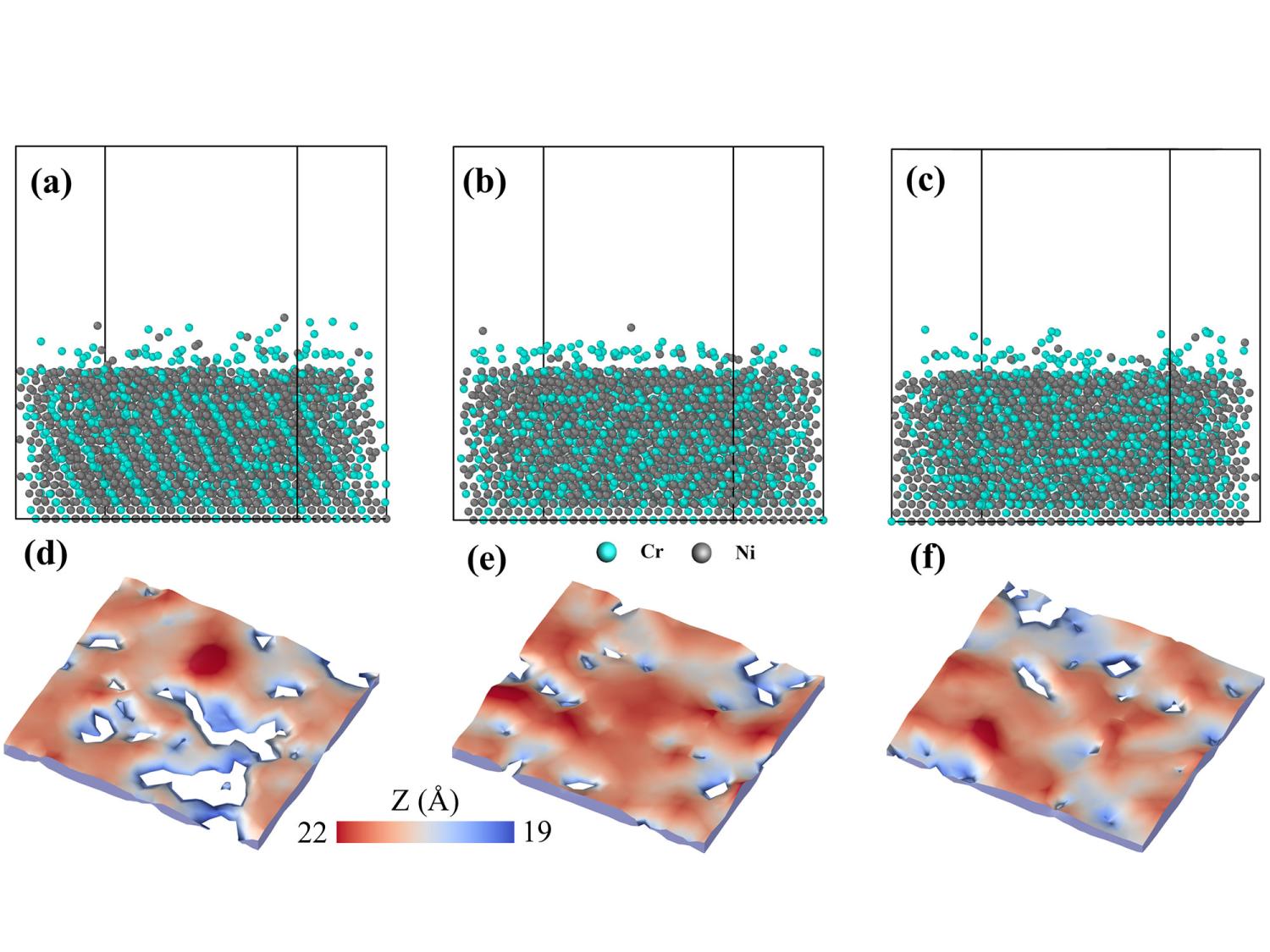
Scientists created hyper-detailed simulations of nichrome, a metal alloy used in nuclear reactors, and exposed them to a popular molten salt mixture used in an advanced type of nuclear reactor. The team found that particular atomic arrangements created “corrosion highways” that made the material much more susceptible to corrosion. Credit: Provided by Hamdy Arkoub. All Rights Reserved.
<関連情報>
- https://www.psu.edu/news/research/story/metals-atomic-arrangement-can-create-corrosion-highways-nuclear-reactors
- https://www.sciencedirect.com/science/article/abs/pii/S0010938X26003690
溶融塩中における化学的に秩序だったNiCr合金の浸透腐食経路 Percolating corrosion pathways of chemically ordered NiCr alloys in molten salts
Hamdy Arkoub, Jia-Hong Ke, Kaustubh Bawane, Miaomiao Jin
Corrosion Science Available online: 22 May 2026
DOI:https://doi.org/10.1016/j.corsci.2026.113960
Highlights
- Long-range ordered Ni2Cr corrodes faster than disordered NiCr alloys.
- Ordering creates percolating Cr pathways that accelerate dissolution.
- Cr network connectivity enables rapid near-surface diffusion and loss.
- DFT shows LRO lowers energetic barrier for Cr detachment in FLiNaK.
Abstract
Recent experiments have shown that chemical ordering in NiCr alloys can significantly accelerate corrosion in molten salt environments. However, the underlying mechanisms remain poorly understood. Using reactive molecular dynamics and first-principles calculations, we show that long-range ordered Ni2Cr in Ni–33at.%Cr alloys corrodes far more rapidly in FLiNaK salt at 800 “C than short-range ordered or random solid solutions. This accelerated attack originates from percolating Cr pathways that enhance near-surface diffusion and a lowered energetic barrier for Cr dissolution. Contrary to earlier explanations that attributed this behavior to residual stresses, our stress-free simulations demonstrate that ordering alone accelerates the degradation. These results establish percolation as a critical link between chemical ordering and corrosion kinetics, offering a mechanistic basis for experimental observations.