2026-07-14 京都大学
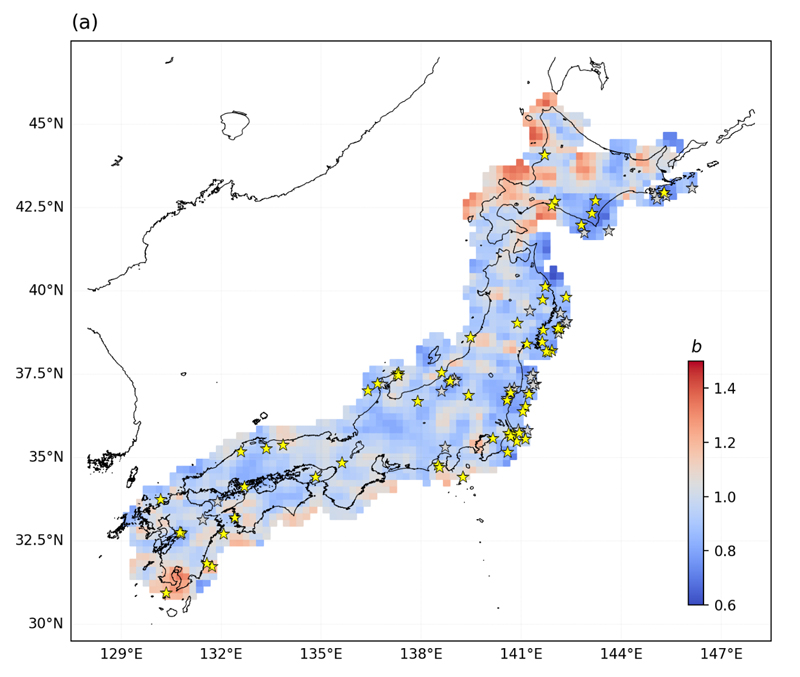
日本周辺におけるb値の空間分布と、マグニチュード(M)6以上の大地震の位置。色はb値を示し、青色ほどb値が低く、赤色ほどb値が高いことを表す。本研究の解析では、大地震は相対的にb値の低い領域で発生しやすい傾向が示された。地図に示したb値分布は、解析対象とした各地震系列に含まれる地震を除外したうえで、周辺地域の地震データに基づいて推定したものである。(図提供:Aron Mirwald博士)
<関連情報>
- https://www.kyoto-u.ac.jp/ja/research-news/2026-07-14
- https://agupubs.onlinelibrary.wiley.com/doi/10.1029/2025GL121450
⼤地震系列の b 値は本震の発⽣場所に依存する b-Values of Large Earthquake Sequences Depend on Their Mainshock Location
Aron Mirwald, Leila Mizrahi, Bogdan Enescu, Stefan Wiemer
Geophysical Research Letters Published: 12 July 2026
DOI:https://doi.org/10.1029/2025GL121450
Abstract
We evaluate four hypotheses regarding b-values in large earthquake sequences using the Japanese earthquake catalog: ℋ1: Around large earthquakes, b-values vary more than expected at random. ℋ2: b-values decrease prior to large earthquakes. ℋ3: After large earthquakes, b-values increase. ℋ4: Large earthquakes localize in regions of lower b-values. We show that ℋ1 is supported for spatial and, to a lesser extent, temporal variation. We find no evidence for a pre-event drop (ℋ2), nor for post-event increase (ℋ3). Large earthquakes occur preferentially in low b-value regions (ℋ4), although the effect is small compared to the b-value range across sequences. Together, the evidence suggests b-values are mainly location-controlled, which we verify with an independent data set. Our results support the view that b-values depend primarily on rock properties and stress regime. This study targets large-scale effects; highly localized shifts in b-values remain to be investigated.