2026-07-13 シカゴ大学(UChicago)
<関連情報>
- https://news.uchicago.edu/story/distant-exoplanets-may-be-hiding-water-beyond-webb-telescopes-reach-study-finds
- https://iopscience.iop.org/article/10.3847/1538-4357/ae64ff
温暖で金属に富むサブネプチューンにおける水と水素の分離の可能性 A Window for Water-hydrogen Demixing on Warm Metal-rich Sub-Neptunes
Caroline Piaulet-Ghorayeb, Daniel P. Thorngren, Eliza M.-R. Kempton, Justin Lipper, Leslie Rogers, Fernanda Correa Horta, and Shi Lin Sun
The Astrophysical Journal Published: 2026 July 13
DOI:10.3847/1538-4357/ae64ff
Abstract
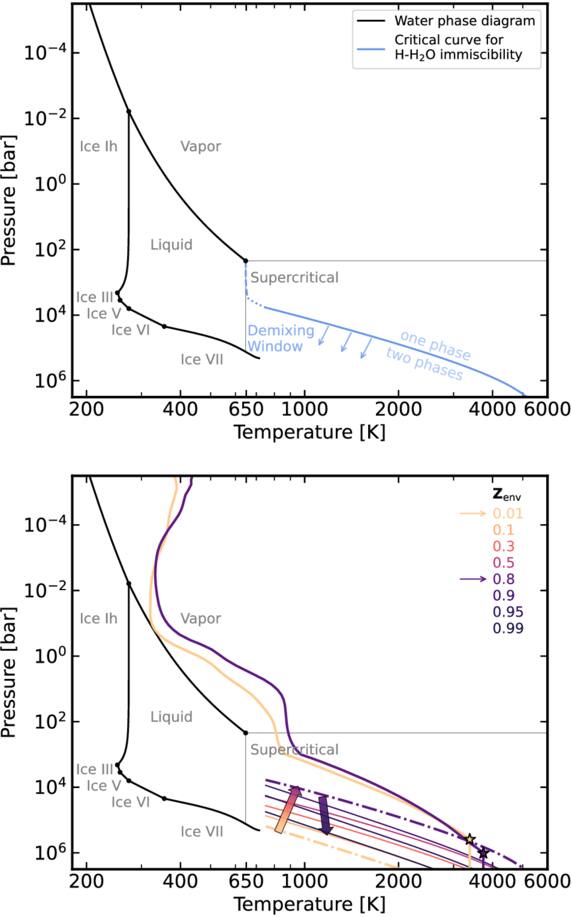
Sub-Neptunes represent the largest exoplanet demographic, yet their bulk compositions remain poorly understood. Recent studies suggested that only very cold planets, such as Uranus and Neptune, could experience stratification of volatiles in their envelopes. Transiting warm sub-Neptunes, with 103–104 times more stellar irradiation, were therefore believed to have fully miscible compositions. Here, we present ATHENAIA, an interior-atmosphere composition inference framework we leverage to assess the potential for water-hydrogen demixing on warm sub-Neptunes and for the 350 K planet TOI-270 d as a case study, using radiative-convective atmosphere models coupled to interior models. We find that the higher temperatures at which hydrogen and water demix in water-rich environments open a window for demixing on sub-Neptunes with bulk envelope metallicities of ∼150–700× solar, compatible with TOI-270 d. Demixing is easier to achieve on more massive and colder planets, but still broadly affects warm (≃330–450 K) metal-rich sub-Neptunes. Therefore, combining atmosphere metallicities with models of fully miscible envelopes may lead to underestimated bulk envelope metallicities and mass fractions. Further, we find that considering the increased greenhouse effect in metal-rich atmospheres in concert with the composition-dependent adiabatic gradient in the convective envelope increases the range of compositions under which molten mantle conditions should be expected on sub-Neptunes. This work encourages a reconsideration of the current paradigm for linking sub-Neptune atmospheres to their interiors and motivates evolutionary modeling describing the onset of metallicity gradients in sub-Neptune envelopes.