2026-06-16 ロイヤルメルボルン工科大学(RMIT)
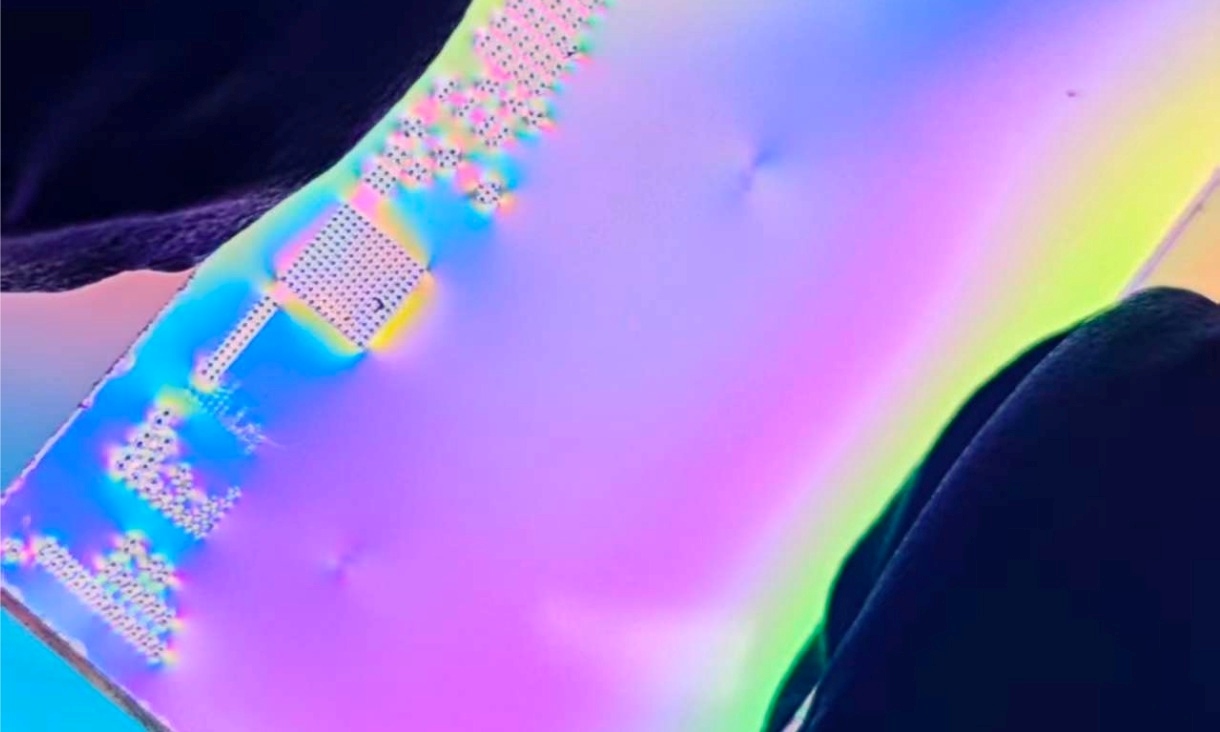
The microscale optical device developed in the study, integrated with imaging hardware to analyse light at the source. Credit: Zhejiang University
<関連情報>
- https://www.rmit.edu.au/news/all-news/2026/jun/camera-chip
- https://www.nature.com/articles/s41928-026-01618-z
熱可塑性ポリマー中の微小渦を利用した集積型マイクロ分光計への光分散 Optical dispersion using micro-vortices in thermoplastic polymers for integrated microspectrometers
Bo Zhang (张博),Shiqi Liu (刘世奇),Fanrong Zeng (曾繁荣),Beibei Xu (许贝贝),Jihong Han (韩佶宏),Han Lin (林瀚),Baohua Jia (贾宝华),Zongyin Yang (杨宗银),Zhuo Wang (王卓) & Jianrong Qiu (邱建荣)
Nature Electronics Published:20 April 2026
DOI:https://doi.org/10.1038/s41928-026-01618-z
Abstract
Miniaturized devices that can split light into different wavelengths are of use in spectroscopic applications such as light analysis, spectral imaging, optical sensing and measurement. However, despite recent developments, achieving a microscale optical dispersion component that can deliver multiple spectral responses without applying external stimuli remains difficult. Here we show that ultrafast-laser-induced micro-vortices in polycarbonate substrates can be used to generate intricate dispersion signals at the microscale. The approach, which is based on the photoelastic effect, can provide rich and varied spectral responses for efficient sampling. The dispersive structures operate over a broad bandwidth (400–1,550 nm), occupy a compact footprint (10 × 10 µm2) and are independent of the viewing angle. The approach is also applicable to different thermoplastic polymers and is robust against harsh conditions. We show that the micro-vortex structures can be integrated with an image sensor for on-chip spectral analysis and high-resolution microscopic spectral imaging.