2026-07-02 シンガポール国立大学(NUS)
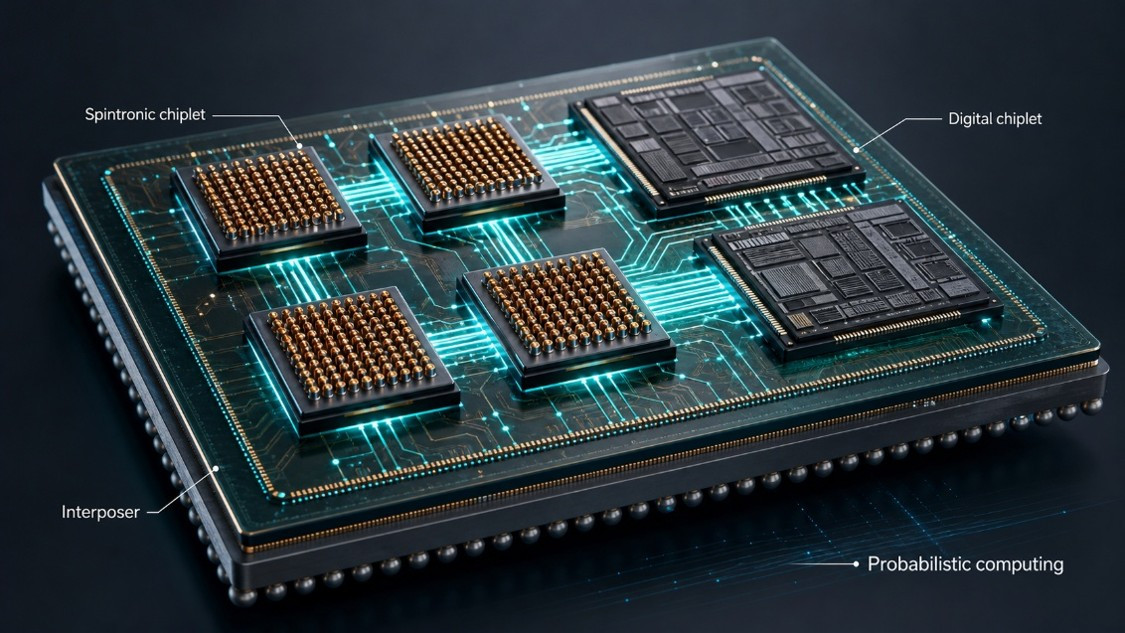
Prof Yang Hyunsoo and his team from the NUS Department of Electrical and Computer Engineering have made breakthroughs in computing by developing novel spintronics-based probabilistic processors that demonstrate gains in both speed and energy efficiency. (Image generated by AI using OpenAI Codex)
<関連情報>
- https://news.nus.edu.sg/nus-researchers-develop-probabilistic-spintronic-processors/
- https://www.nature.com/articles/s41467-026-72020-8
- https://www.nature.com/articles/s41467-026-71128-1
250個の磁気トンネル接合に基づく確率的イジングマシン 250 magnetic tunnel junctions-based probabilistic Ising machine
Shuhan Yang,Andrea Grimaldi,Youwei Bao,Eleonora Raimondo,Jia Si,Giovanni Finocchio & Hyunsoo Yang
Nature Communications Published:17 April 2026
DOI:https://doi.org/10.1038/s41467-026-72020-8
Abstract
In combinatorial optimization, probabilistic Ising machines have gained significant attention for their acceleration of Monte-Carlo sampling with the potential to reduce time-to-solution in finding approximate ground states. However, to be viable in real applications, further advances in scalability and energy efficiency are necessary. Here, we experimentally demonstrate a scalable probabilistic Ising machine based on 250 spin-transfer-torque magnetic tunnel junctions. Our computing approach integrates spintronic tunable true random number generators with advanced annealing techniques. For sparsely connected graphs, the proposed massive parallel architecture enables a cluster parallel update method that overcomes the serial limitations of Gibbs sampling, leading to a 10 times acceleration without hardware changes. Furthermore, we prove experimentally that the simulated quantum annealing boosts solution quality 20 times over conventional simulated annealing while also increasing robustness to device variability. In addition, we propose a next generation chiplet-based architecture for future large-scale, high-performance, and energy-efficient unconventional computing hardware.
効率的な二次最適化のための並列磁気トンネル接合型確率的イジングプロセッサ A parallel magnetic tunnel junction-based probabilistic Ising processor for efficient quadratic optimization
Shuhan Yang,Youwei Bao,Edward Humianto,Anil Prabhakar & Hyunsoo Yang
Nature Communications Published:30 March 2026
DOI:https://doi.org/10.1038/s41467-026-71128-1
Abstract
Solving computationally demanding combinatorial optimization problems using conventional computing architectures is slow and energy intensive. Quantum computing could improve optimization efficiency but remains at an early stage. Probabilistic computing offers a practical near-term approach to faster optimization through stochastic techniques. Here, we experimentally demonstrate a scalable spin-transfer-torque-magnetic-tunnel-junction based probabilistic processor for efficiently solving all-to-all connected quadratic assignment problems. Our system integrates 144 compact spintronics tunable random number generators with a massively parallel architecture, achieving a high Monte-Carlo sampling throughput of 14.4 million flips per second. We co-design a parallel trial annealing scheme, and the integrated system achieves a 123× speedup with 98.3% energy savings over conventional Gibbs sampling, and a 3.2× speedup with 58.3% energy savings relative to the central processing unit implementation based on a compiled language. We further benchmark performance across graphics processing unit, and D-Wave quantum annealers, showing gains in solution quality, speed, and energy efficiency.