2026-07-14 東北大学
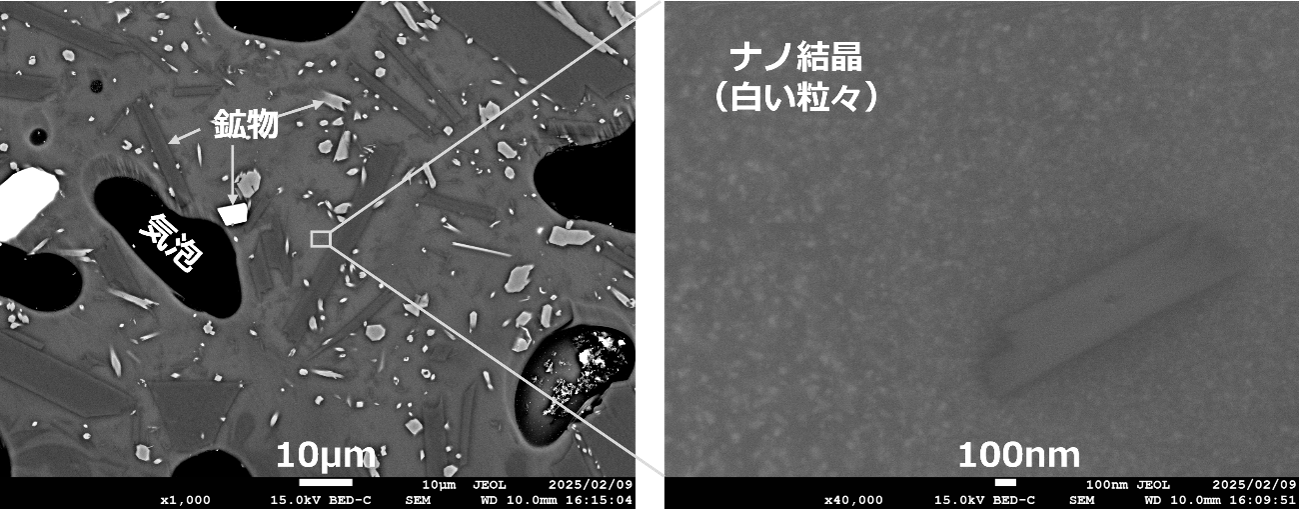
図1. (左)天然の火山噴出物中(霧島火山新燃岳2011年噴火)に観察されるナノ結晶の電子顕微鏡像(反射電子像)と、その均質な火山ガラスに見える場所(□)を拡大したもの(右)
<関連情報>
- https://www.tohoku.ac.jp/japanese/2026/07/press20260714-04-magma.html
- https://pubs.geoscienceworld.org/gsa/geology/article/doi/10.1130/G54466.1/733751/When-and-how-Fe-oxide-nanocrystals-form-Insights
鉄酸化物ナノ結晶はいつ、どのように形成されるのか:現場FE-SEMによる知見と噴火ダイナミクスへの示唆
When and how Fe-oxide nanocrystals form: Insights from in situ FE-SEM and implications for eruption dynamics
Mayumi Mujin;Michihiko Nakamura
Geology Published:July 09, 2026
DOI:https://doi.org/10.1130/G54466.1
Nanocrystals (nanolites and ultrananolites) in volcanic rocks have attracted considerable attention owing to their potential role in increasing magma viscosity and serving as heterogeneous nucleation sites for bubbles, thereby influencing eruption styles. However, the conditions, time scales, and mechanisms of their formation remain poorly constrained. In this study, we conducted high-temperature, in situ observations of crystallization in a rhyolitic silicate melt using field-emission scanning electron microscopy. Nucleation of fine-grained Fe-oxide crystals (≤100 nm in width and diameter) occurred at high number densities (∼1020−1021 m−3) under sub-solidus and oxidizing conditions, whereas their growth into coarser nanolites was not observed. The fastest case of beginning crystallization was ∼35 s after the melt reached the target temperature. Under above-solidus conditions, nucleation occurred at substantially lower number densities (≤∼1019 m−3) and crystal growth dominated with time. Nucleation under sub-solidus and oxidizing conditions was likely facilitated by spinodal-type liquid immiscibility between Fe-rich and Fe-poor melts. These results suggest that high-number-density ultrananolites formed through liquid immiscibility may serve as indicators of shallow magmatic processes but are unlikely to control the occurrence of Plinian eruptions in deep conduits. Rapid nucleation of Fe-oxide ultrananolites could allow their detection in pumice from explosive eruptions.