2026-06-09 ワシントン大学(UW)

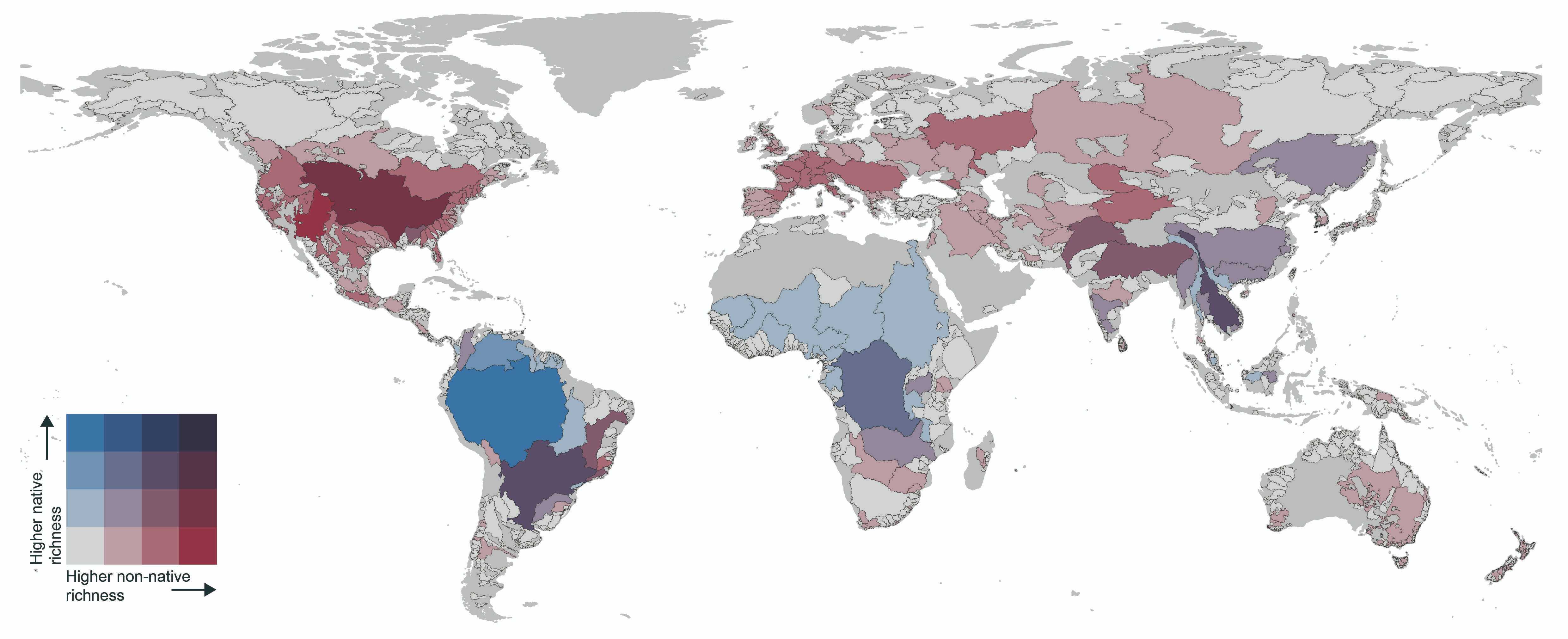
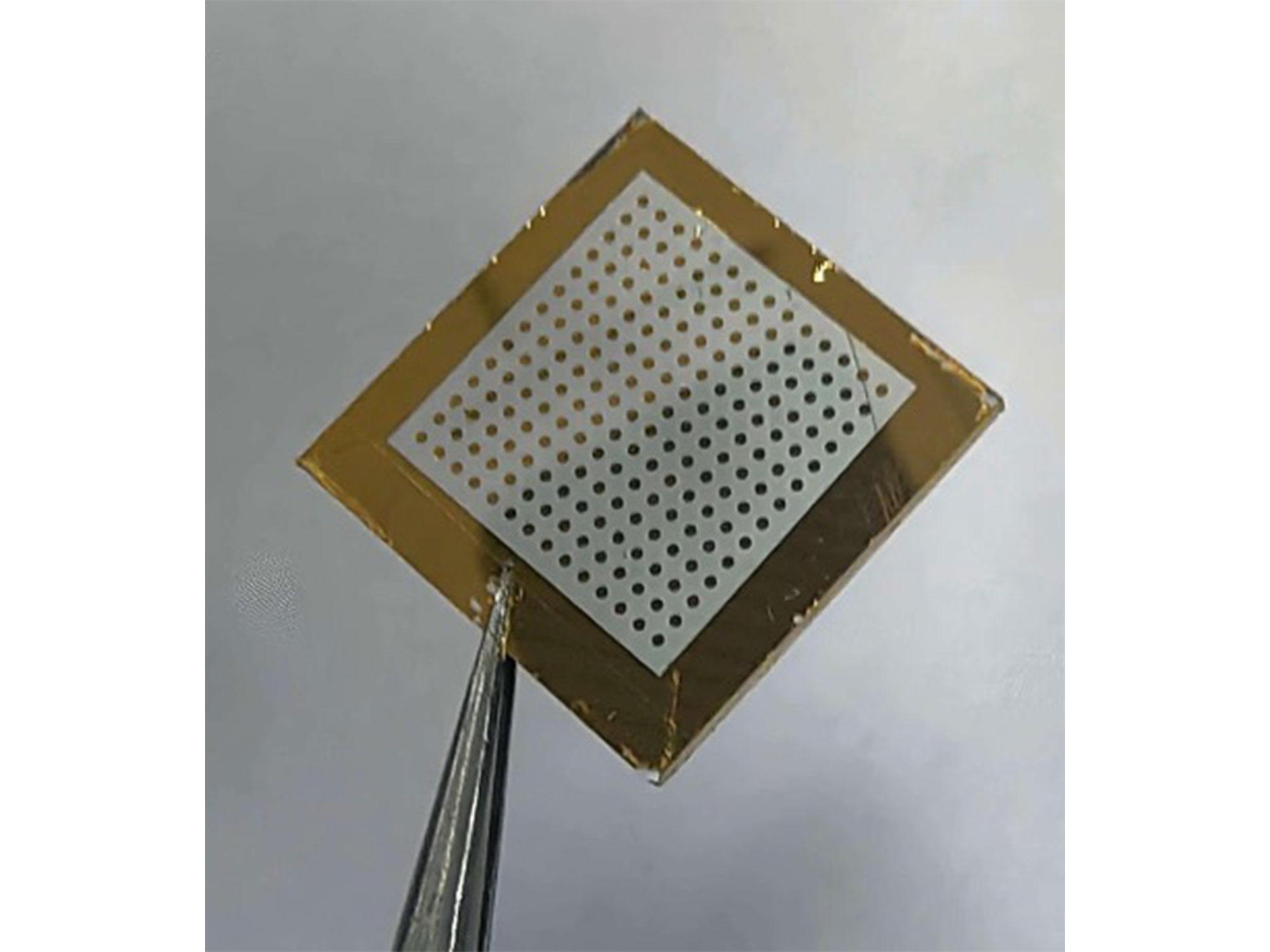
Sheets of molybdenum ditelluride crystals, when stacked on top of one another in a specific way, create the complex lattice structure seen above. In a new study, materials scientists at the University of Washington used artificial intelligence to simulate huge stacks of these sheets, producing new quantum phenomena that were not present at smaller scales. Photo: Yueyao Fan
<関連情報>
- https://www.washington.edu/news/2026/06/09/quantum-materials-ai-artificial-intelligence-quantum-computing/
- https://www.nature.com/articles/s41467-026-72769-y
- https://www.pnas.org/doi/10.1073/pnas.2532550123
量子プロセッサ上でのフェルミオンラフリン状態の実現 Realization of fermionic Laughlin state on a quantum processor
Lingnan Shen,Mao Lin,Cedric Yen-Yu Lin,Di Xiao & Ting Cao
Nature Communications Published:08 June 2026
DOI:https://doi.org/10.1038/s41467-026-72769-y
Abstract
Strongly correlated topological phases of matter are central to modern condensed matter physics and quantum information technology but often challenging to probe and control in material systems. The experimental difficulty of accessing these phases has motivated the use of engineered quantum platforms for simulation and manipulation of exotic topological states. Among these, the Laughlin state stands as a cornerstone for topological matter, embodying fractionalization, anyonic excitations, and incompressibility. Although its bosonic analogs have been realized on programmable quantum simulators, a genuine fermionic Laughlin state has yet to be demonstrated on a quantum processor. Here, we realize the ν = 1/3 fermionic Laughlin state on IonQ’s trapped-ion quantum computer using an efficient and scalable Hamiltonian variational ansatz with 369 two-qubit gates on a 16-qubit circuit. Employing symmetry-verification error mitigation, we extract key observables that characterize the Laughlin state, including correlation hole, bulk-edge correspondence, and topological entanglement entropy, with strong agreement to exact diagonalization benchmarks. This work demonstrates an end-to-end workflow to simulate material-intrinsic topological orders and provides a starting point to explore its dynamics and excitations on digital quantum processors.
ねじれた多層MoTe₂における層状構造とバンド再配列 Layerwise stratification and band reordering in twisted multilayer MoTe2
Yueyao Fan, Xiao-Wei Zhang, Yusen Ye, +4 , and Ting Cao
Proceedings of the National Academy of Sciences Published:June 2, 2026
DOI:https://doi.org/10.1073/pnas.2532550123
Significance
Multilayer graphene moiré systems have revealed rich correlated and topological quantum phases, yet twisted transition metal dichalcogenides have been studied mainly as bilayer. Here we show that adding more layers changes the underlying physics: In twisted multilayer MoTe2, the moiré interface and adjacent bulk-like layers undergo structural stratification, forming sharply distinct structural environments rather than a smooth interlayer transition. We also identify electronic stratification, in which the valence states localize into spatially separated regions with different lattice patterns and enable twist- or gate-tunable band reordering between states with different topology, observable via electronic polarizations. A machine learning force field reaching ab initio accuracy at large scales across all configurations is also developed, enabling predictive exploration of complex quantum materials.
Abstract
We introduce a physics-informed training-data generation strategy that efficiently captures the complete interlayer interactions in multilayer moiré systems, enabling a machine-learning force field transferable across layer numbers and stacking configurations, beyond twist angles. Applying this to multilayer twisted MoTe2 (tMoTe2), we identify a structural and electronic stratification: The two moiré interface (MI) layers retain substantial lattice reconstruction even in thick multilayers, while outer bulk-like layers show rapidly attenuated distortions. Surprisingly, this stratification becomes strongest not in the ultrasmall twist angle regime (≲1°), where in-plane domain formation is well known, but rather at intermediate angles (2 to 5°). Simultaneously, interlayer hybridization across the MI–bulk boundary is strongly suppressed, leading to electronic isolation. In twisted double bilayer MoTe2, this stratification gives rise to coexisting honeycomb and triangular lattice motifs in the frontier valence bands. We further demonstrate that twist angle and weak gating can create energy shift of bands belonging to the two motifs, producing Chern band reordering and nonlinear electric polarization with modest hole doping. Our approach allows efficient simulation of multilayer moiré systems and reveals structural–electronic separation phenomena absent in bilayer systems.