2026-07-24 沖縄科学技術大学院大学
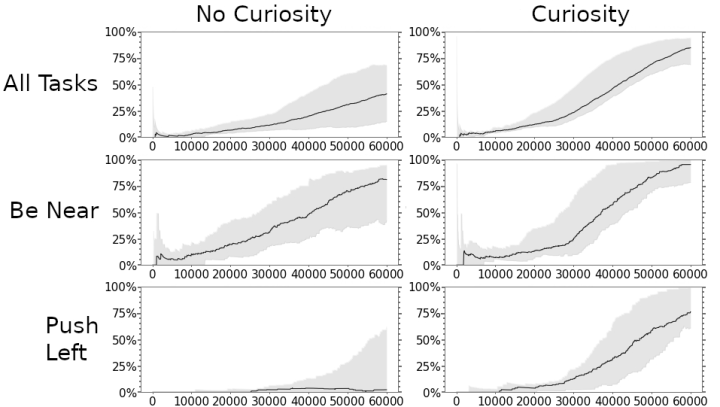
「緑色の柱のそばにいて」や「左側のマゼンタ色のダンベルを押して」といった言語課題を、ロボットが6万回試行した際の成功率。© ティンカー他(2026年)を基に作成。
<関連情報>
- https://www.oist.jp/ja/news-center/news/2026/7/24/curious-robots-mimic-how-children-can-learn-understand-language
- https://www.science.org/doi/10.1126/sciadv.aee7533
好奇心に基づく自己探求を通じたロボットの動作と言語の発達 Curiosity-driven development of action and language in robots through self-exploration
Theodore J. Tinker, Kenji Doya, and Jun Tani
Science Advances Published:23 Jul 2026
DOI:https://doi.org/10.1126/sciadv.aee7533
Abstract
Infants acquire language with generalization from minimal experience, whereas large language models require billions of training tokens. What underlies efficient development in humans? We investigated this problem through experiments wherein robotic agents learn to perform actions associated with imperative sentences (e.g., push red cube) via curiosity-driven self-exploration. Our approach amortizes active inference using Q-learning, enabling intrinsically motivated developmental learning. The simulations reveal key findings corresponding to observations in developmental psychology. (i) Generalization improves markedly as the scale of compositional elements increases. (ii) Curiosity-driven exploration enables faster learning. (iii) Rote pairing of sentences and actions precedes compositional generalization. (iv) Exception handling induces U-shaped developmental performance, a pattern like representational redescription in child language learning. These results suggest that curiosity-driven active inference accounts for how intrinsically motivated sensorimotor-linguistic learning supports scalable compositional generalization and exception handling in humans and artificial agents.