2026-07-23 日本原子力研究開発機構
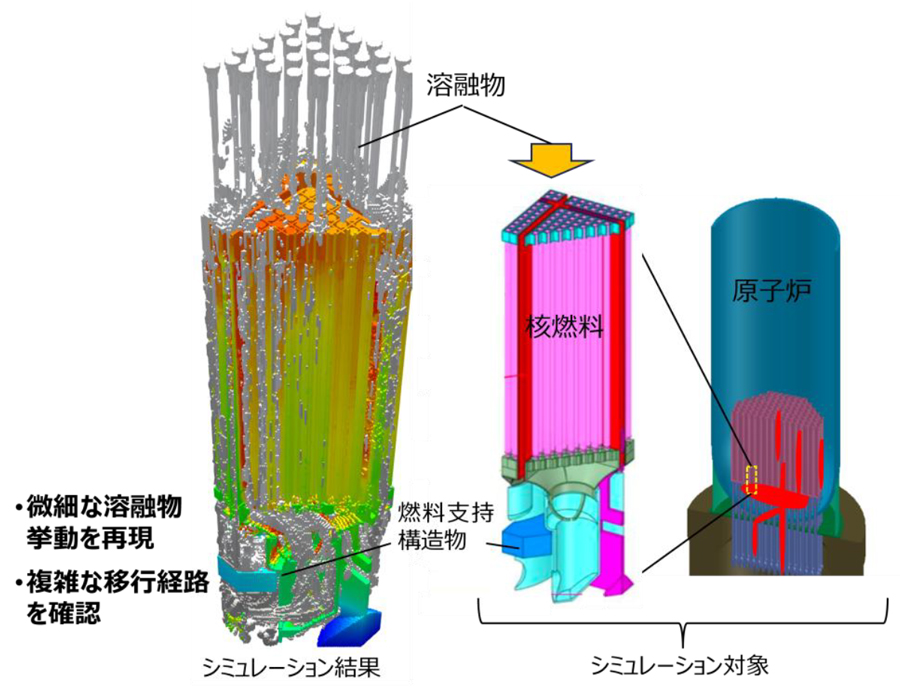
原子炉内部のシミュレーション対象領域と溶融物移行挙動
<関連情報>
- https://www.jaea.go.jp/02/press2026/p26072301/
- https://www.tandfonline.com/doi/full/10.1080/00223131.2026.2664459
JUPITERコードを用いたXR2-1実験のCFDシミュレーション CFD simulation of the XR2-1 experiment with the JUPITER code
Susumu Yamashita & Hiroyuki Yoshida
Journal of Nuclear Science and Technology Published:28 Apr 2026
DOI:https://doi.org/10.1080/00223131.2026.2664459
ABSTRACT
This study investigates the applicability of the mechanistic CFD code JUPITER to three-dimensional melt relocation phenomena in nuclear reactor cores during severe accidents. The XR2-1 BWR metallic melt relocation experiment was analyzed as an integral-effect test case focusing exclusively on melt relocation behavior under an inert atmosphere. A detailed three-dimensional model of the XR2-1 test section, including fuel assemblies, control blades, and lower core support structures, was constructed, and time-dependent injections of SS/B4C and Zircaloy melts were simulated under experimentally based thermal conditions. The simulation results were evaluated through qualitative comparisons of melt relocation paths and quantitative comparisons of relocated material volumes in key regions of the test section. The analysis successfully reproduced the three experimentally observed melt relocation paths – through the control blade guide tube, nosepiece and inlet nozzle, and along the channel box region – without the formation of internal blockages. Quantitative comparisons showed reasonable agreement with post-test X-ray tomographic measurements for most evaluation regions. These results demonstrate that JUPITER can realistically capture three-dimensional melt relocation behavior in complex core geometries and indicate its potential usefulness as a complementary tool to large-scale experiments for evaluating severe accident melt relocation phenomena. This study identifies major problems in analyzing fuel assembly melt relocation behavior using the current JUPITER code, including the excessive computational cost of radiative heat‑transfer calculation, insufficient computational grid resolution, and the absence of fluid – structure interaction modeling.