
2026-06-30 パシフィック・ノースウェスト国立研究所(PNNL)
<関連情報>
- https://www.pnnl.gov/publications/moving-toward-more-effective-quantum-simulations-molecular-dynamics
- https://pubs.aip.org/aip/jcp/article/164/10/104113/3383265/Elucidating-many-body-effects-in-molecular-core
- https://pubs.aip.org/aip/jcp/article/164/8/084103/3380942/A-fractional-calculus-framework-for-open-quantum
リアルタイムアプローチによる分子コアスペクトルにおける多体効果の解明:効率的な古典近似と量子論的視点 Elucidating many-body effects in molecular core spectra through real-time approaches: Efficient classical approximations and a quantum perspective
Vibin Abraham;Priyabrata Senapati;Himadri Pathak;Bo Peng
The Journal of Chemical Physics Published:March 12 2026
DOI:https://doi.org/10.1063/5.0313721
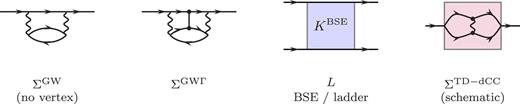
Accurately resolving many-body satellite features in molecular core-level spectra requires theoretical approaches that capture electron correlation both efficiently and systematically. The recently developed time-dependent double coupled-cluster (TD-dCC) Ansatz achieves this by combining correlation effects from the N– and (N − 1)-electron sectors, but its exact formulation remains computationally demanding. Here, we introduce a hierarchy of cost-effective approximate TD-dCC-truncated Baker–Campbell–Hausdorff (BCH) expansions, which preserve a single-similarity-transformation structure while retaining the essential correlation diagrams responsible for satellite formation. We further develop a detailed component analysis that isolates hole-mediated excitation pathways—correlated processes arising from the coupling between ground-state and ionized-state amplitudes—and use it to interpret quasiparticle and satellite features across the hierarchy. Applications to the single-impurity Anderson model and molecular systems (H2O and CH4) demonstrate that the approximate TD-dCC methods closely and efficiently reproduce exact many-body spectral features and quasiparticle weights. In parallel, we construct a fault-tolerant quantum signal processing algorithm for the core-hole Green’s function, providing a scalable quantum route for simulating correlated core-level dynamics. Together, these developments establish complementary classical and quantum methodologies for quantitative, many-body-accurate core spectroscopy.
開放型量子力学のための分数階微積分フレームワーク:リウヴィルからリンドブラッド、そして記憶カーネルへ A fractional calculus framework for open quantum dynamics: From Liouville to Lindblad to memory kernels
Bo Peng;Yu Zhang
The Journal of Chemical Physics Published:February 23 2026
DOI:https://doi.org/10.1063/5.0312309
Open quantum systems exhibit dynamics ranging from unitary evolution to irreversible dissipation. While the Gorini–Kossakowski–Sudarshan–Lindblad equation uniquely characterizes Markovian completely positive and trace-preserving (CPTP) evolution, many physical platforms display non-Markovian features such as algebraic relaxation and coherence backflow. Fractional calculus provides a natural way to model such long-memory behavior through power-law temporal kernels introduced by fractional time derivatives. Here, we develop a unified framework that embeds fractional master equations within the broader hierarchy of open-system formalisms. The fractional equation forms a structured subclass of memory-kernel models, reduces to the Lindblad form at unit order, and, through Bochner–Phillips subordination, admits a CPTP representation as an average over Lindblad semigroups. Its resolvent structure further connects fractional dynamics to established non-Markovian approaches, including Nakajima–Zwanzig kernels and hierarchical equations of motion, providing a compact surrogate for long-memory effects. This formulation positions fractional calculus as a rigorous and practical language for modeling non-Markovian quantum dynamics in chemical physics and physical chemistry, providing a CPTP-preserving, computationally efficient surrogate for structured condensed-phase environments where long-time memory and dissipation play a central role.
