2026-07-21 中国科学院(CAS)
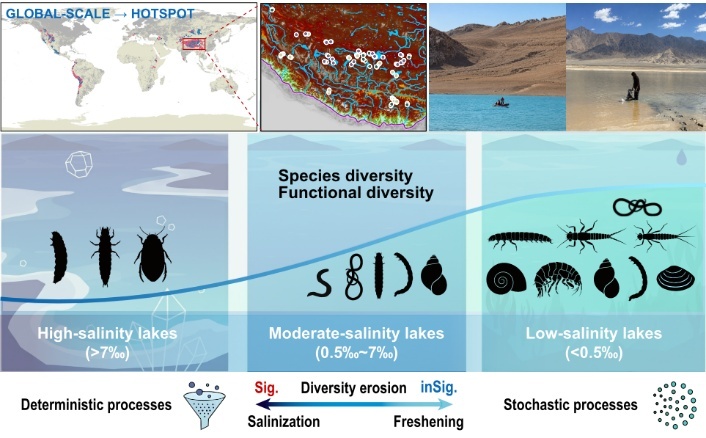
Salinity-driven biodiversity erosion and community assembly shifts in the global alpine lake hotspot. (Image by IHB)
<関連情報>
- https://english.cas.cn/newsroom/research-news/202607/t20260724_1179131.shtml
- https://pubs.acs.org/esthag/article/60/28/19842/5205032/Salinity-Variation-Reshapes-Macroinvertebrate
塩分濃度の変化が高山湖の大型無脊椎動物群集を再編成する Salinity Variation Reshapes Macroinvertebrate Communities in Alpine Lakes
Baoqiang Wang;Xiong Xiong;Jiahao Zhang;Yongjing Zhao;Xiongdong Zhou ;Yongde Cui
Environmental Science & Technology Published:July 10, 2026
DOI:https://doi.org/10.1021/acs.est.6c03770
Abstract
Global lakes have experienced unprecedented salinity variation in recent decades, yet its ecological consequences in high-altitude ecosystems remain poorly resolved. Here, we quantified global patterns of salinity variation in alpine lakes and conducted extensive field surveys at 77 littoral sites across 40 lakes on the Qinghai–Tibet Plateau, which hosts nearly 40% of the world’s alpine lakes and spans a broad salinity gradient (0.05–45‰). We integrated multidimensional diversity and assembly mechanism analyses to assess macroinvertebrate responses to salinity variation. Salinity emerged as the dominant measured correlate of macroinvertebrate communities across alpine lakes. Across taxonomic and functional dimensions, local diversity decreased monotonically with rising salinity. Community assembly shifted sharply along the gradient: deterministic filtering dominated high-salinity lakes (>7‰), mixed processes characterized moderate salinity (0.5–7‰), and low salinity (<0.5‰) exhibited a higher apparent stochastic component that may partly reflect unmeasured deterministic factors. At the taxon level, three contrasting adaptive strategies─strict halophiles, broadly euryhaline taxa, and low-optimum but wide-tolerance groups─revealed pronounced ecological divergence under saline stress. Simulated salinity variation further indicated asymmetric responses of regional biodiversity and functional distinctiveness, with salinization causing greater losses than freshening. Moderate-salinity lakes represented a critical mechanistic threshold, where the balance between deterministic and stochastic processes shifted and where regional diversity erosion accelerated. These findings suggest that salinity variation structures alpine lake macroinvertebrate communities across multiple biodiversity dimensions and assembly pathways, with important implications for conserving high-altitude ecosystems under ongoing global environmental change.