2026-06-09 ペンシルベニア州立大学(Penn State)
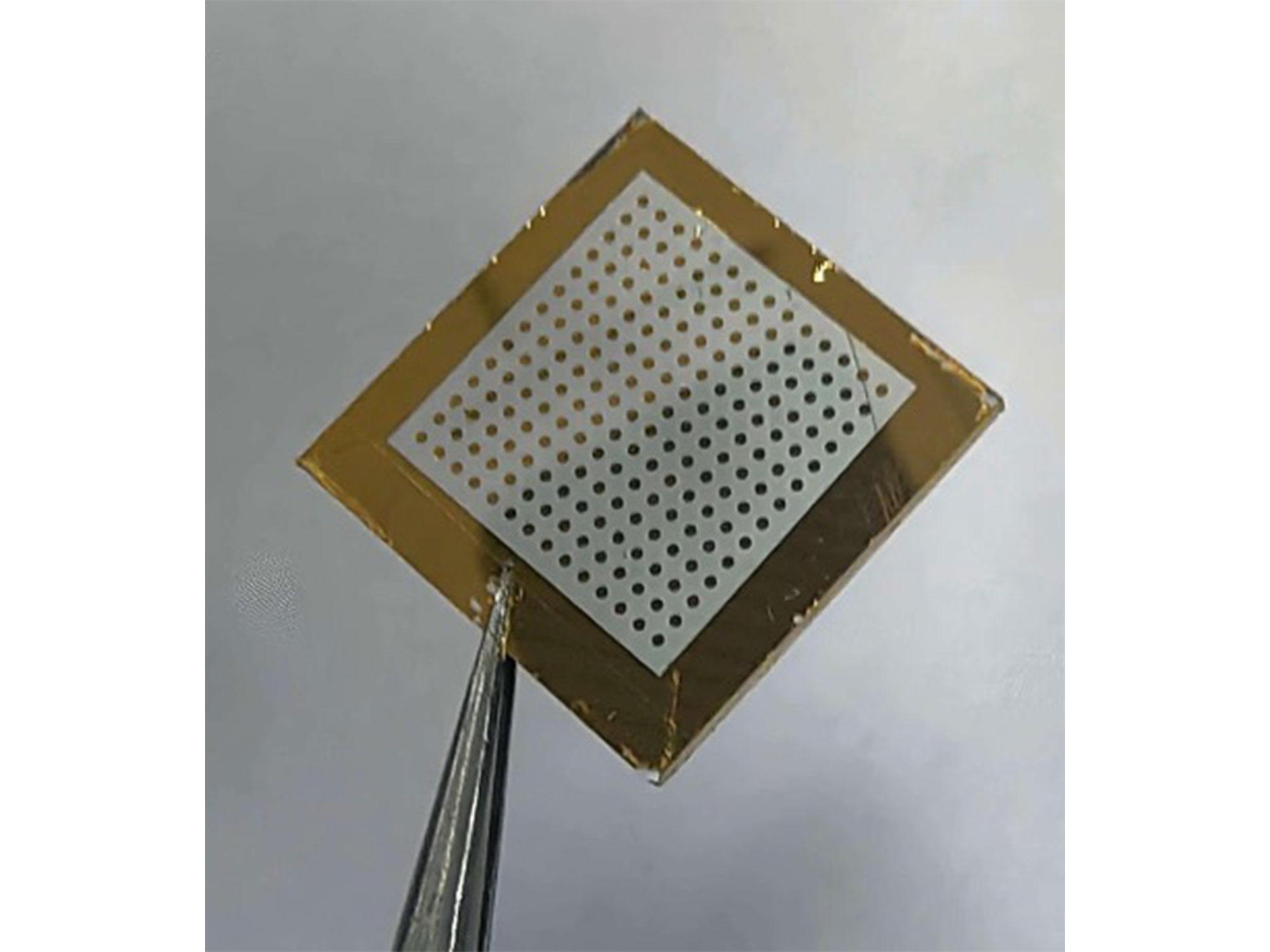
The team’s photomemristor is quite small, measuring only half a millimeter across. Despite its size, the component can convert light energy into electrical current to power advanced optical systems. Credit: Provided by Jia Zhu. All Rights Reserved.
<関連情報>
- https://www.psu.edu/news/research/story/artificial-eyes-could-bring-human-sight-self-driving-cars-robots
- https://www.nature.com/articles/s41467-026-73217-7
動的な水の吸着/脱着によって実現される、混合光条件下での完全な視覚適応 Full vision adaptation in mixed-light conditions enabled by dynamic water adsorption/desorption
Jia Zhu,Wantao Liu,Wanxin Huang,Xiangjie Chen,Xuewei Feng,Xin Luo,Kai Xu,Min Gao,Haifeng Ling,Chaoyun Song,Huanyu Cheng & Yuan Lin
Nature Communications Published:09 June 2026
DOI:https://doi.org/10.1038/s41467-026-73217-7
Abstract
Mimicking the human eye’s ability to autonomously adapt to diverse and mixed illumination conditions remains a fundamental challenge in artificial vision systems. Although substantial progress has been made in materials and device engineering, current adaptive vision architectures still depend heavily on complex circuitry or algorithms and are typically restricted to uniform illumination owing to the strong intensity-dependence of photosensitivity. Here, this work presents a highly adaptive TiO₂/PEDOT:PSS photomemristor that leverages the tunable conductivity of PEDOT:PSS together with the optoelectronic response of TiO₂. The photothermal effect dynamically modulates the water absorption/desorption equilibrium in PEDOT:PSS, enabling reversible suppression or enhancement of photosensitivity under bright or dim illumination, respectively. By combining with artificial neural networks (ANNs), the artificial vision system based on TiO₂/PEDOT:PSS photomemristor arrays achieves a high accuracy of 91.3% in image recognition under mixed-light conditions—without the need for complex circuitry or algorithms. This work may establish a new approach for designing autonomous, efficient, and high-performance neuromorphic vision systems to advance the development of autonomous driving and humanoid robots.