2026-06-05 量子科学技術研究機構
◆従来のPETは、医療用で約4mm、実験動物用でも1~2mm程度が限界であり、感度と高分解能の両立が長年の課題だった。研究チームは、放射線を光に変換するシンチレータを3層構造とした多層検出器を開発し、感度を維持したまま高精細な位置情報を取得できるようにした。さらに、445ピクセルの信号を効率的に圧縮処理する独自技術を導入し、高性能化を実現した。その結果、生きたマウス脳内の数百マイクロメートル規模の微細構造をPETで可視化することに成功した。
◆分解能を1mmから0.5mmへ改善することは理論上8倍の情報量増加に相当し、脳機能研究や認知症・神経疾患を対象とした創薬研究の効率化が期待される。今後は医療用PETへの応用により、がんや認知症の超早期診断や治療効果評価の高度化への貢献が見込まれる。
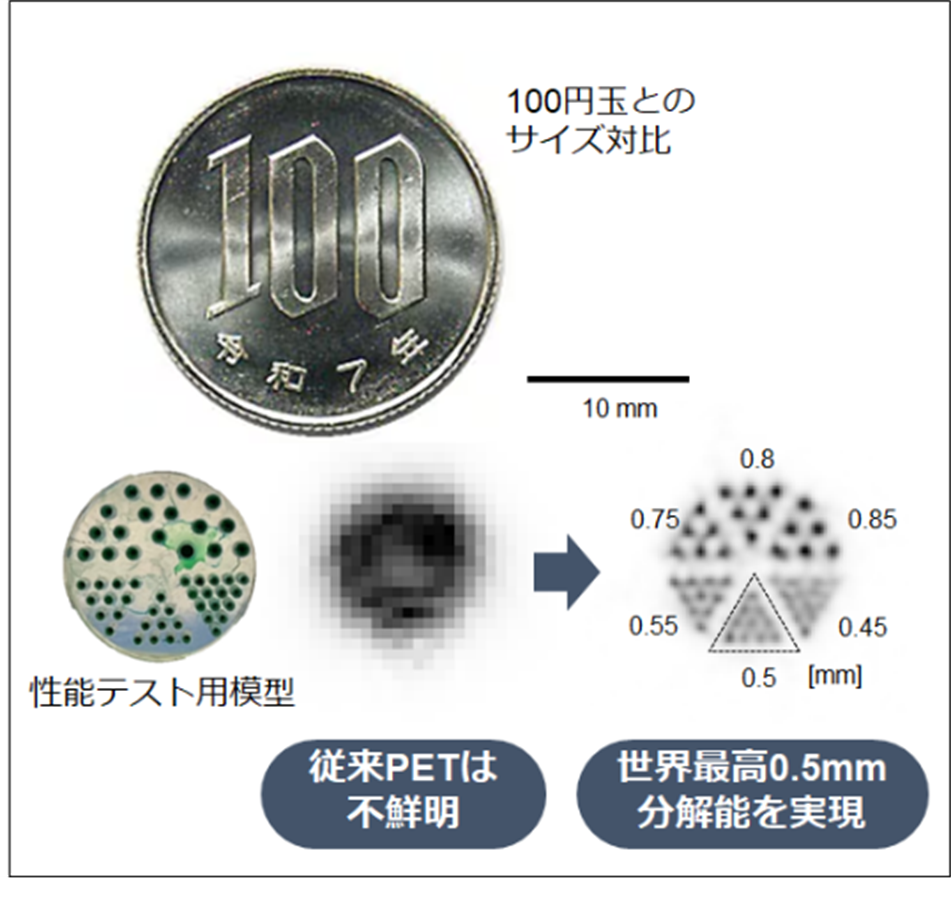
図1 分解能を実証した実験結果
<関連情報>
- https://www.qst.go.jp/site/press/20260605.html
- https://jnm.snmjournals.org/content/early/2026/06/04/jnumed.125.271600
0.5mm以下の解像度PETとオートラジオグラフィーの比較:マウス脳におけるmGluR1濃度の比較 Sub–0.5-mm Resolution PET Versus Autoradiography: Comparison of mGluR1 Concentrations in Mouse Brain
Han Gyu Kang, Hideaki Tashima, Hidekatsu Wakizaka, Takeharu Minamihisamatsu, Tomoteru Yamasaki, Masayuki Fujinaga, Ming-Rong Zhang, Makoto Higuchi and Taiga Yamaya
Journal of Nuclear Medicine Published:June 2026
DOI: https://doi.org/10.2967/jnumed.125.271600
Abstract
For mouse brain PET imaging with high quantification accuracy, ultrahigh resolution is essential. Metabotropic glutamate receptors are important molecular targets, linked to various neurologic diseases. Here, we report the comparison of in vivo mouse brain images obtained with sub–0.5-mm resolution PET and those obtained with autoradiography using 4-18F-fluoro-N-[4-[6-(isopropylamino)pyrimidin-4-yl]-1,3-thiazol-2-yl]-N-methylbenzamide (18F-FITM) that binds to metabotropic glutamate receptor subtype 1. Methods: We recently developed a sub–0.5-mm resolution PET scanner having an axial coverage of 23.4 mm and an inner diameter of 48 mm. The PET scanner comprises 32 depth-of-interaction detectors, each of which has staggered 3-layer lutetium–yttrium–orthosilicate crystal arrays with a pitch of 0.8 mm. A resolution phantom was used to evaluate the imaging performance of the PET scanner. Dynamic PET imaging was performed to evaluate the concentration changes of 18F-FITM at various mouse brain regions. In vivo metabotropic glutamate receptor imaging of a mouse brain was performed using 18F-FITM and the PET scanner. Subsequently, autoradiography images of the same mouse brain were obtained using 18F-FITM. Results: The 0.45-mm rod structure was resolved with the PET scanner. Time–activity curves of various mouse brain regions were obtained. The sub–0.5-mm resolution PET visualized 18F-FITM uptake in the mouse brain with high correlation to the autoradiography images. Conclusion: The sub–0.5-mm resolution PET opens up new opportunities for translational neuroscience research using mice models.