
2026-07-24 フランス国立科学研究センター(CNRS)
<関連情報>
- https://www.cnrs.fr/en/press/pfas-neurological-effects-identified-birds-and-mice
- https://pubs.acs.org/estlcu/article-abstract/doi/10.1021/acs.estlett.6c00433/5231026/Brain-Response-after-Exposure-to-Fluorotelomer?redirectedFrom=fulltext
フルオロテロマーカルボン酸への曝露後の脳反応:鳥類およびげっ歯類モデルにおける領域特異的な神経炎症および行動リモデリングの証拠 Brain Response after Exposure to Fluorotelomer Carboxylic Acid: Evidence of Region-Specific Neuroinflammation and Behavioral Remodeling in Avian and Rodent Models
Jerome Badaut;Christophe J. Dubois;William Jouanneau;Mathilde Malinconi;Ines Brochet;Elisa Dauriac;Richard Rouland;Geir Wing Gabrielsen;Claire Bottini;Frédéric Angelier;Olivier Chastel
Environmental Science & technology Letters Published:July 23, 2026
DOI:https://doi.org/10.1021/acs.estlett.6c00433
Abstract
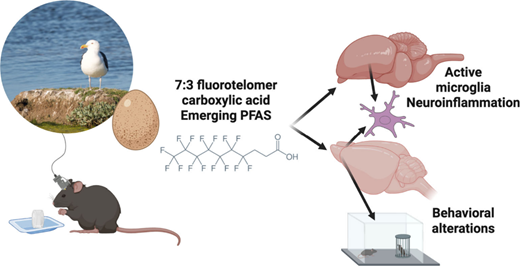
Poly- and perfluoroalkyl substances (PFAS) are persistent organic pollutants that pose health and environmental concerns. Although a few legacy PFAS are regulated, the toxicity of less scrutinized substances, precursors, and breakdown products is not well investigated. Fluorotelomer alcohols (FTOHs) are volatile precursors to perfluorinated carboxylic acids, including 7:3 fluorotelomer carboxylic acid (7:3FTCA), which is increasingly found in wildlife tissues. This study investigates the neurotoxicity of 7:3FTCA at an environmentally relevant concentration, using a comparative approach in gull embryos and adult mice. In gulls, 7:3FTCA exposure via egg injection induced significant neuroinflammation specifically in the pallium. In mice, a three-week exposure via food intake caused behavioral remodeling, marked by reduced photophobia and increased social interaction. Behavioral alteration in mice was associated with a 20% increase in prefrontal cortex (PFC) calcium activity and microglial activation. Our study reveals region-specific sensitivity (pallium/PFC) without overt neuronal loss, suggesting that 7:3FTCA drives functional brain remodeling, possibly through microglia-mediated pathways rather than acute cell death. These findings provide the first evidence of a neurotoxic response to fluorotelomer carboxylic acids in wildlife and laboratory models, highlighting a critical need to reassess the neurological risks of PFASs beyond legacy compounds.

