2026-07-24 合肥物質科学研究院(HFIPS)
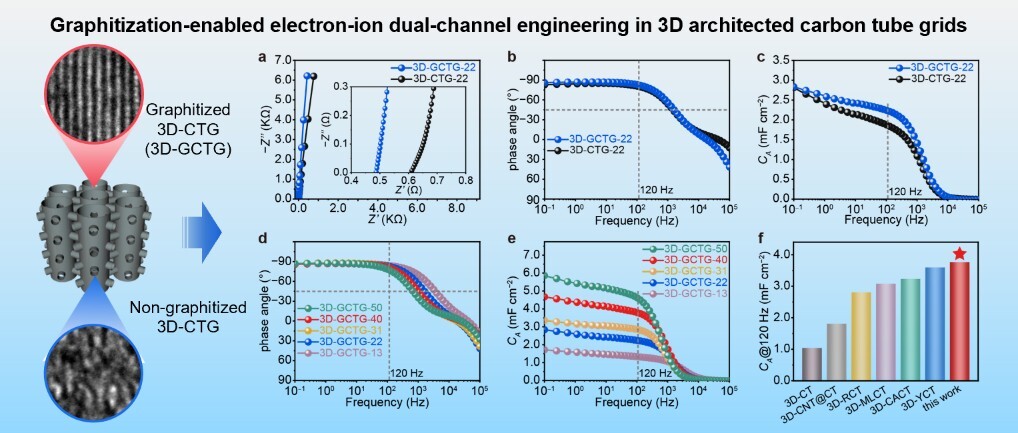
Structural schematics and electrochemical performance of 3D-GCTG and 3D-CTG (from 3D nanoporous anodic aluminum oxide template-assisted chemical vapor deposition). (Image by HAN Fangming)
<関連情報>
- https://english.hf.cas.cn/nr/rn/202607/t20260724_1178956.html
- https://advanced.onlinelibrary.wiley.com/doi/10.1002/adma.73249
結晶構造を制御した三次元グラファイトカーボンチューブグリッドをACラインフィルタリングコンデンサ用耐負荷電極として用いる Crystallinity-Engineered Three-Dimensional Graphitic Carbon Tube Grids as Load-Tolerant Electrodes for AC Line-Filtering Capacitors
Pei Li, Fangming Han, Dou Lin, Ziyan Zhou, Gan Chen, Qijun Pan, Haibin Tang, Guowen Meng, Bingqing Wei
Advanced Materials Published: 07 May 2026
DOI:https://doi.org/10.1002/adma.73249
ABSTRACT
Three-dimensionally (3D) architected carbons with oriented nanopores provide a promising platform for AC line-filtering electric double-layer capacitors (EDLCs). However, their performance, particularly at high electrode loading, is fundamentally constrained by insufficient electronic conduction—an intrinsic but largely overlooked limitation. Here, we develop a crystallinity-engineered, highly conductive 3D graphitic carbon tube grid (3D-GCTG) using a 3D nickel nanorod grid (3D-NiNRG) as both structural template and catalytic framework. A central advance lies in elucidating and resolving structural collapse and granulation in 3D-NiNRG during catalytic graphitization, enabling a fully interconnected, well-graphitized carbon network with a predefined 3D microstructure. A direct comparison between two carbon tube grids with identical structures and thicknesses but different crystallinities unambiguously reveals the crystallinity-enabled enhancement in frequency response. This synergistic ion-electron transport allows the 3D-GCTG to function as a load-tolerant electrode, effectively decoupling areal capacitance from phase angle. In a two-electrode configuration, the 3D-GCTG maintains a phase angle below −80° at 120 Hz even at 40 µm, delivering a high areal capacitance of 3.77 mF cm−2, a 3.6-fold improvement over the previously reported non-graphitized counterpart. This work establishes graphitization-enabled transport engineering as a general strategy for overcoming the long-standing capacitance-response trade-off, offering a versatile platform for high-performance AC-filtering EDLCs.