2026-04-27 東京科学大学
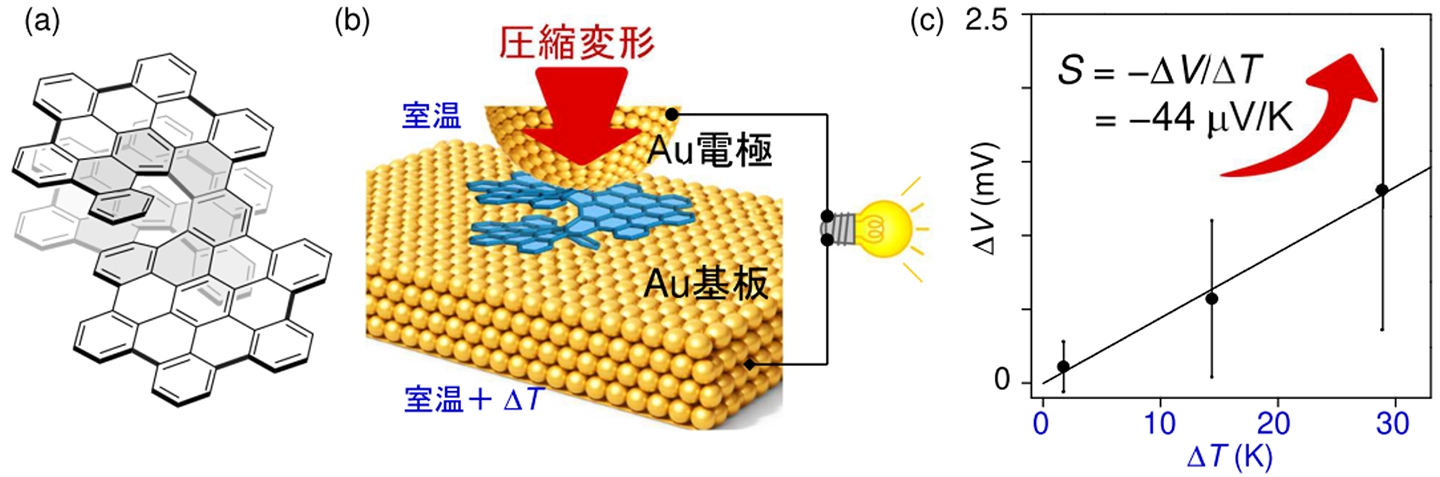
図1. (a)本研究で設計したπ拡張ヘリセン分子の基本骨格。(b)実験系の模式図。(c)熱起電力測定より明らかになった圧縮変形に伴う熱電能(ゼーベック係数:s )の変化。
<関連情報>
部分的にπ電子が露出した3Dカルボヘリセンを用いた、単分子接合におけるコンダクタンスと熱電能の機械的調整 Partially π-exposed 3D carbohelicene for mechanical tuning of conductance and thermopower in single-molecule junctions
Shintaro Fujii,Futo Morita,Kanato Takahashi,Juntaro Nogami,Yuko Kishida,Haruki Goto,Ryota Shimizu,Tomoaki Nishino,Hidehiro Uekusa & Ken Tanaka
Nature Communications Published:27 April 2026
DOI:https://doi.org/10.1038/s41467-026-71293-3
Abstract
Helicenes, composed of ortho-fused benzene rings, possess a spring-like π-backbone, enabling electron delocalization through both bonds and space. Theoretical predictions suggest that mechanical stretching or compression of molecular junctions in higher-order diazahelicenes could increase conductance and thermopower. However, this theory has not been experimentally verified, likely due to the difficulty of forming robust higher-order helicene molecular junctions using existing heteroatom anchors and the high electrical resistance of metal–heteroatom bonds. Thus, constructing mechanically stable single-molecule junctions through multipoint metal–π interactions would be ideal. Here we verify this theory using a 3D carbohelicene with a shielded π-face bearing bulky tert-butyl groups and an exposed π-face lacking tert-butyl groups. This partially π-exposed 3D carbohelicene forms a robust monolayer on the Au(111) substrate at room temperature through multipoint metal–π interactions. Using the break-junction technique, we demonstrate a compression-induced increase in both peak conductance (10–3–10–2 G0) and thermopower (−44 μV/K).