2026-04-28 京都大学
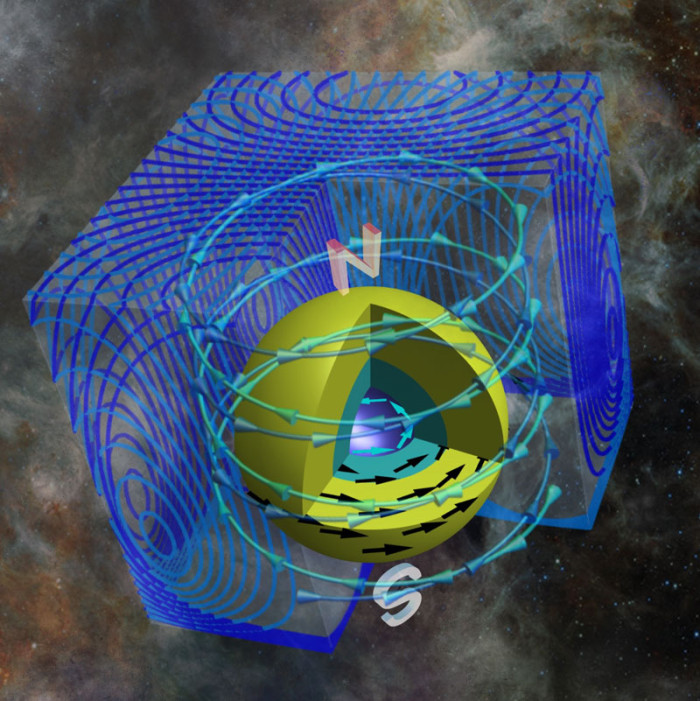
重力崩壊直前の大質量星内部のイラスト。激しい対流が生じている酸素燃焼殻(緑色)、ケイ素燃焼殻(黄色)が示されている。箱内に磁場構造が投影されており、矢印で自転速度が示されている。酸素燃焼殻での対流・自転・磁場の相互作用によって自転率が加速あるいは減速する。(Credit: Lucy O. McNeill))
<関連情報>
- https://www.kyoto-u.ac.jp/ja/research-news/2026-04-28-0
- https://iopscience.iop.org/article/10.3847/1538-4357/ae53da
高速回転する核崩壊型前駆星の3次元MHDシミュレーションにおける対流層での角運動量輸送 Angular Momentum Transport in the Convection Zone of a 3D MHD Simulation of a Rapidly Rotating Core-collapse Progenitor
Ryota Shimada, Lucy O. McNeill, Vishnu Varma, Keiichi Maeda, Takaaki Yokoyama, and Bernhard Müller
The Astrophysical Journal Published: 2026 April 27
DOI:10.3847/1538-4357/ae53da
Abstract
Rotation and magnetic fields in the cores of evolved massive stars in their final phase are thought to play an important role in the subsequent supernova explosion and the formation of a compact object, especially in hyperenergetic explosions. However, the interplay between rotation, magnetic fields, and convection up to the final collapse is a nonlinear, multidimensional effect that is difficult to capture with standard one-dimensional (1D) stellar evolution models. We quantify the magnetic angular momentum (AM) transport in the convective oxygen-burning shell in a three-dimensional (3D) rotating core-collapse progenitor model. We find that the radial direction of magnetic AM transport is directly related to the Rossby number of the convective oxygen shell. We also analyze the magnetic energy, which sets the amplitude of the magnetic AM flux. The magnetic energy is determined both by rotation and the nuclear energy generation rate, in a manner analogous to that for low-mass stars like the Sun. Based on these results, we construct a 1D model of magnetic AM transport in the convection zone for the first time in terms of properties of a given stellar evolution model. This model successfully reproduces the AM transport in the 3D model when the convective dynamo is in a quasi-steady state. Notably, our model for radial AM transport is the first to account for inward AM flux. This may result in interesting differences compared to the conventional treatment of magnetic AM transport in stellar evolution models, which assume AM is transported outward by a purely diffusive process.