2026-04-28 京都大学
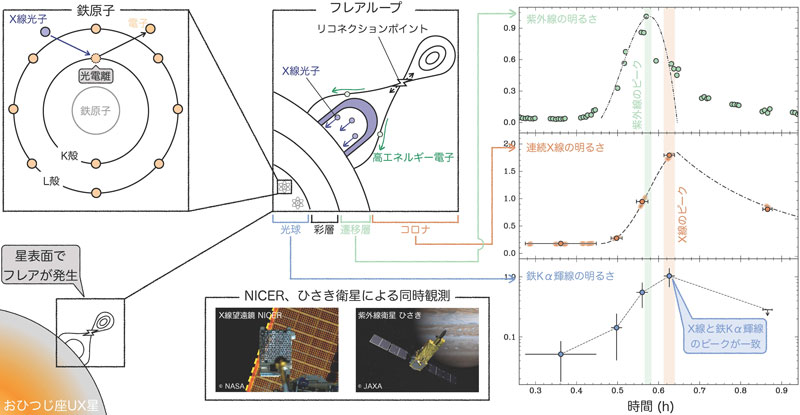
本研究の概要図。おひつじ座UX星で発生した恒星フレアを「NICER」と「ひさき」衛星で同時観測することで、X線・紫外線の時間変化を調べ、連続X線と鉄Kα輝線のピークの一致を捉えた。
<関連情報>
- https://www.kyoto-u.ac.jp/ja/research-news/2026-04-28
- https://iopscience.iop.org/article/10.3847/1538-4357/ae2be0
RS CVn型星UX Arietis におけるスーパーフレアの遠紫外線・X線観測が明らかにした恒星Fe Kα輝線の起源 Origin of the Stellar Fe Kα Line Clarified with Far-ultraviolet and X-Ray Observations of a Superflare on the RS Canum Venaticorum–type Star UX Arietis
Shun Inoue, Wataru Buz Iwakiri, Tomoki Kimura, Teruaki Enoto, Yuta Notsu, Hiroyuki Uchida, Kenji Hamaguchi, Shin Toriumi, Atsushi Yamazaki, Fuminori Tsuchiya,…
The Astrophysical Journal Published: 2026 April 27
DOI:10.3847/1538-4357/ae2be0
Abstract
Fluorescence line diagnostics of the Fe Kα line at ∼6.4 keV observed in both solar and stellar flares can constrain the latitude and size of the flare loop, even in the absence of imaging observations. However, they are hampered by the unresolved origin of stellar Fe Kα lines; i.e., it is unclear which of two mechanisms—photoionization by hard X-ray photons or collisional ionization by nonthermal electrons—is the dominant process. We present clear evidence for the photoionization origin based on simultaneous far-ultraviolet (FUV) and soft X-ray observations of a superflare on the RS Canum Venaticorum–type star UX Arietis with the Extreme Ultraviolet Spectroscope for Exospheric Dynamics instrument (900−1480 Å) on board the Hisaki and Neutron Star Interior Composition Explorer (0.2−12 keV). The flare started at 22:50 UT on 2018 November 15 and released 2 × 1036 erg in the 900−1480 Å band and 3 × 1036 erg in the 0.3−4 keV band. The FUV emission, a proxy for nonthermal activity, peaked approximately 1.4 hr before the soft X-rays. In contrast, the Fe Kα line, detected at a statistical significance of 5.3σ with an equivalent width of 67+28-20 eV, peaked simultaneously with the thermal X-ray maximum rather than the nonthermal FUV peak—strongly supporting the photoionization hypothesis. Radiative transfer calculations, combined with the observed Fe Kα line intensity, further support the photoionization scenario and demonstrate the potential of this line to provide the flare geometry.