
2024-08-07 コロンビア大学
<関連情報>
- https://news.columbia.edu/news/making-contact-quantum-realm
- https://www.nature.com/articles/s41565-024-01702-5
- https://arxiv.org/abs/2406.03418
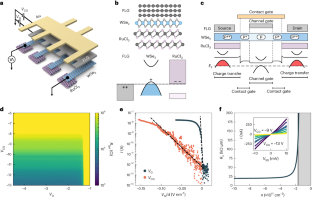
高移動度WSe2における相関状態測定のための電荷移動コンタクト Charge-transfer contacts for the measurement of correlated states in high-mobility WSe2
Jordan Pack,Yinjie Guo,Ziyu Liu,Bjarke S. Jessen,Luke Holtzman,Song Liu,Matthew Cothrine,Kenji Watanabe,Takashi Taniguchi,David G. Mandrus,Katayun Barmak,James Hone & Cory R. Dean
Nature Nanotechnology Published:25 July 2024
DOI:https://doi.org/10.1038/s41565-024-01702-5
Abstract
Two-dimensional semiconductors, such as transition metal dichalcogenides, have demonstrated tremendous promise for the development of highly tunable quantum devices. Realizing this potential requires low-resistance electrical contacts that perform well at low temperatures and low densities where quantum properties are relevant. Here we present a new device architecture for two-dimensional semiconductors that utilizes a charge-transfer layer to achieve large hole doping in the contact region, and implement this technique to measure the magnetotransport properties of high-purity monolayer WSe2. We measure a record-high hole mobility of 80,000 cm2 V–1 s–1 and access channel carrier densities as low as 1.6 × 1011 cm−2, an order of magnitude lower than previously achievable. Our ability to realize transparent contact to high-mobility devices at low density enables transport measurements of correlation-driven quantum phases including the observation of a low-temperature metal–insulator transition in a density and temperature regime where Wigner crystal formation is expected and the observation of the fractional quantum Hall effect under large magnetic fields. The charge-transfer contact scheme enables the discovery and manipulation of new quantum phenomena in two-dimensional semiconductors and their heterostructures.
ツイスト二層WSe2における超伝導 Superconductivity in twisted bilayer WSe2
Yinjie Guo, Jordan Pack, Joshua Swann, Luke Holtzman, Matthew Cothrine, Kenji Watanabe, Takashi Taniguchi, David Mandrus, Katayun Barmak, James Hone, Andrew J. Millis, Abhay N. Pasupathy, Cory R. Dean
arXiv Submitted on 5 Jun 2024
DOI:https://doi.org/10.48550/arXiv.2406.03418

Abstract
The discovery of superconductivity in twisted bilayer and twisted trilayer graphene has generated tremendous interest. The key feature of these systems is an interplay between interlayer coupling and a moiré superlattice that gives rise to low-energy flat bands with strong correlations. Flat bands can also be induced by moiré patterns in lattice-mismatched and or twisted heterostructures of other two-dimensional materials such as transition metal dichalcogenides (TMDs). Although a wide range of correlated phenomenon have indeed been observed in the moiré TMDs, robust demonstration of superconductivity has remained absent. Here we report superconductivity in 5 degree twisted bilayer WSe2 (tWSe2) with a maximum critical temperature of 426 mK. The superconducting state appears in a limited region of displacement field and density that is adjacent to a metallic state with Fermi surface reconstruction believed to arise from antiferromagnetic order. A sharp boundary is observed between the superconducting and magnetic phases at low temperature, reminiscent of spin-fluctuation mediated superconductivity. Our results establish that moiré flat-band superconductivity extends beyond graphene structures. Material properties that are absent in graphene but intrinsic among the TMDs such as a native band gap, large spin-orbit coupling, spin-valley locking, and magnetism offer the possibility to access a broader superconducting parameter space than graphene-only structures.

