2026-04-14 韓国基礎科学研究院(IBS)
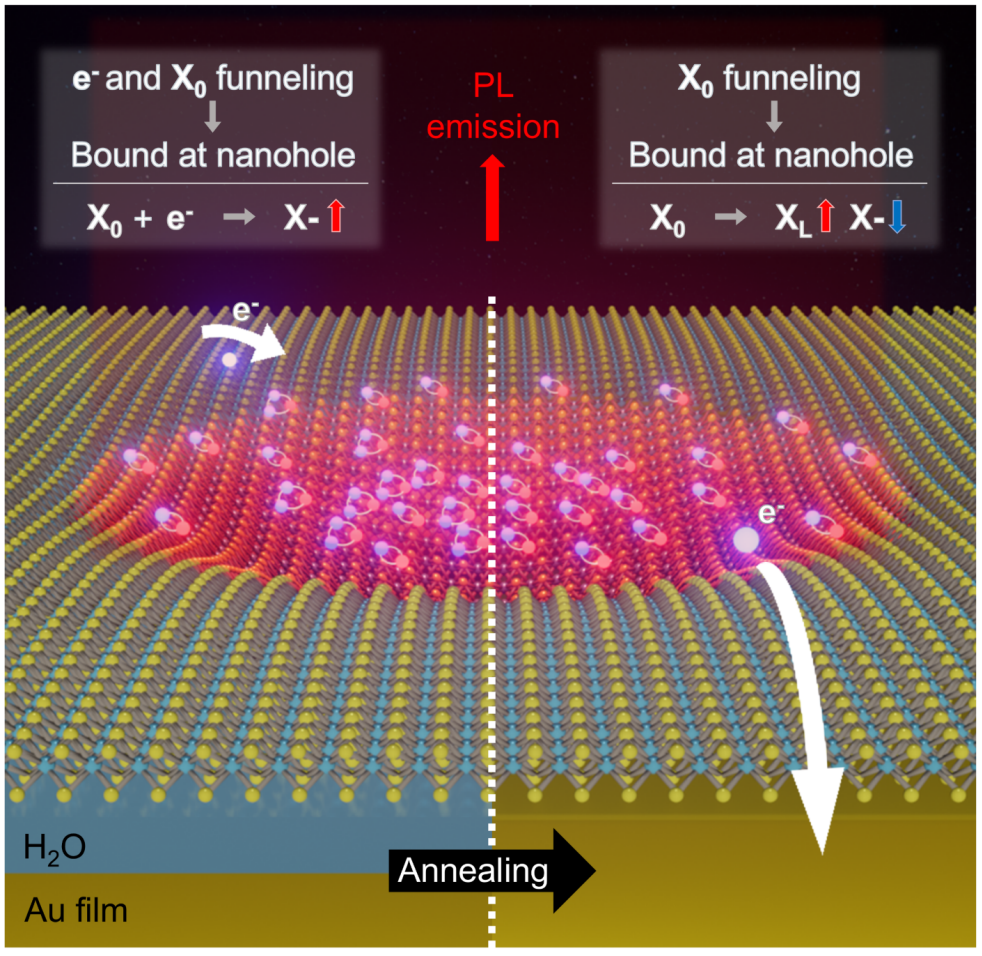
Figure 1. Mechanism for achieving high-efficiency emission of localized excitons through charge neutralization via thermal annealing
<関連情報>
- https://www.ibs.re.kr/cop/bbs/BBSMSTR_000000000738/selectBoardArticle.do?nttId=26633&pageIndex=1&searchCnd=&searchWrd=
- https://www.science.org/doi/10.1126/sciadv.ady2186
2次元半導体中の電荷中和された0次元量子井戸によって実現される、室温で局在化した励起子の高放射性発光 Highly radiative emission of room temperature–localized excitons enabled by charge-neutralized 0D quantum wells in 2D semiconductors
Taeyoung Moon, Hyeongwoo Lee, Jihae Lee, Dong Kyo Oh, […] , and Kyoung-Duck Park
Science Advances Published:13 Mar 2026
DOI:https://doi.org/10.1126/sciadv.ady2186
Abstract
Nondiffusing localized excitons (XL) in two-dimensional semiconductors present a robust platform for mediating light-matter interactions, with potential applications in both photovoltaics and light-emitting devices. However, at room temperature, high thermal energy hinders XL formation, while excess charges diminish the quantum yield (QY) through nonradiative decay. Here, we present high-QY XL emission in ambient conditions by removing excess charges and inducing efficient exciton funneling into a Au nanohole. Specifically, by evaporating an H2O barrier between the n-type MoS2 and the Au substrate, we induce a grounding effect on electrons. Dominantly populating excitons are then funneled and bound to the nanohole through the strain-induced zero-dimensional quantum well effect. We confirm the exciton confinement efficiency of ~98% using a drift-diffusion model, enabling bright XL emission at the nanoscale. Using tip-induced gigapascal-scale pressure, we control XL dynamics and QY in a reversible manner. Our approach provides an innovative strategy for XL-based nanophotonic devices.