2026-04-09 東北大学
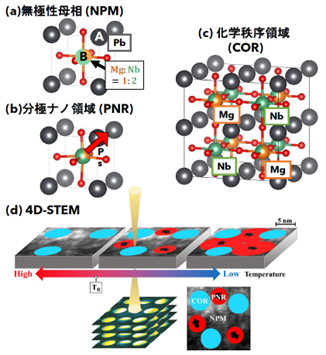
図1. 材料内部のナノ領域の構造を示す概念図と、本研究で用いた最先端の電子顕微鏡の手法(4D-STEM)のイメージ。
<関連情報>
- https://www.tohoku.ac.jp/japanese/2026/04/press20260409-01-nano.html
- https://www.tohoku.ac.jp/japanese/newimg/pressimg/tohokuuniv-press20260409_01web_nano.pdf
- https://pubs.aip.org/aip/apl/article-abstract/128/14/142901/3386222/Direct-imaging-of-temperature-evolution-of-polar
PMNリラクサーにおける極性ナノ領域および化学的に秩序だった領域の温度変化の直接イメージング:極性相パーコレーションの証拠
Direct imaging of temperature evolution of polar nanoregions and chemically ordered regions in PMN relaxor: Evidence for polar phase percolation
Kohei Hino;Daisuke Morikawa;Desheng Fu;Mitsuru Itoh;Kenji Tsuda
Applied Physics Letters Published:April 06 2026
DOI:https://doi.org/10.1063/5.0297426
Polar nanoregions (PNRs) are central to understanding the exceptional dielectric and piezoelectric properties of relaxor ferroelectrics and are key to advancing dielectrics for high-energy storage. However, direct real-space imaging of their formation and evolution remains a major challenge in condensed matter physics. Here, we report the real-space mappings of both PNRs and chemically ordered regions (CORs) in the prototypical relaxor Pb(Mg1/3Nb2/3)O3 and their temperature dependence using convergent-beam electron diffraction combined with four-dimensional scanning transmission electron microscopy. The results reveal that CORs, with sizes of 2–5 nm, remain static with temperature and act to suppress PNR growth. In contrast, PNRs evolve from isolated 2–5 nm regions at room temperature to interconnected structures ∼10 nm in size at low temperatures, indicative of a percolation transition. These observations support the random-field model, in which PNRs emerge from a paraelectric matrix and their growth and collective interactions are constrained by random local fields associated with CORs.